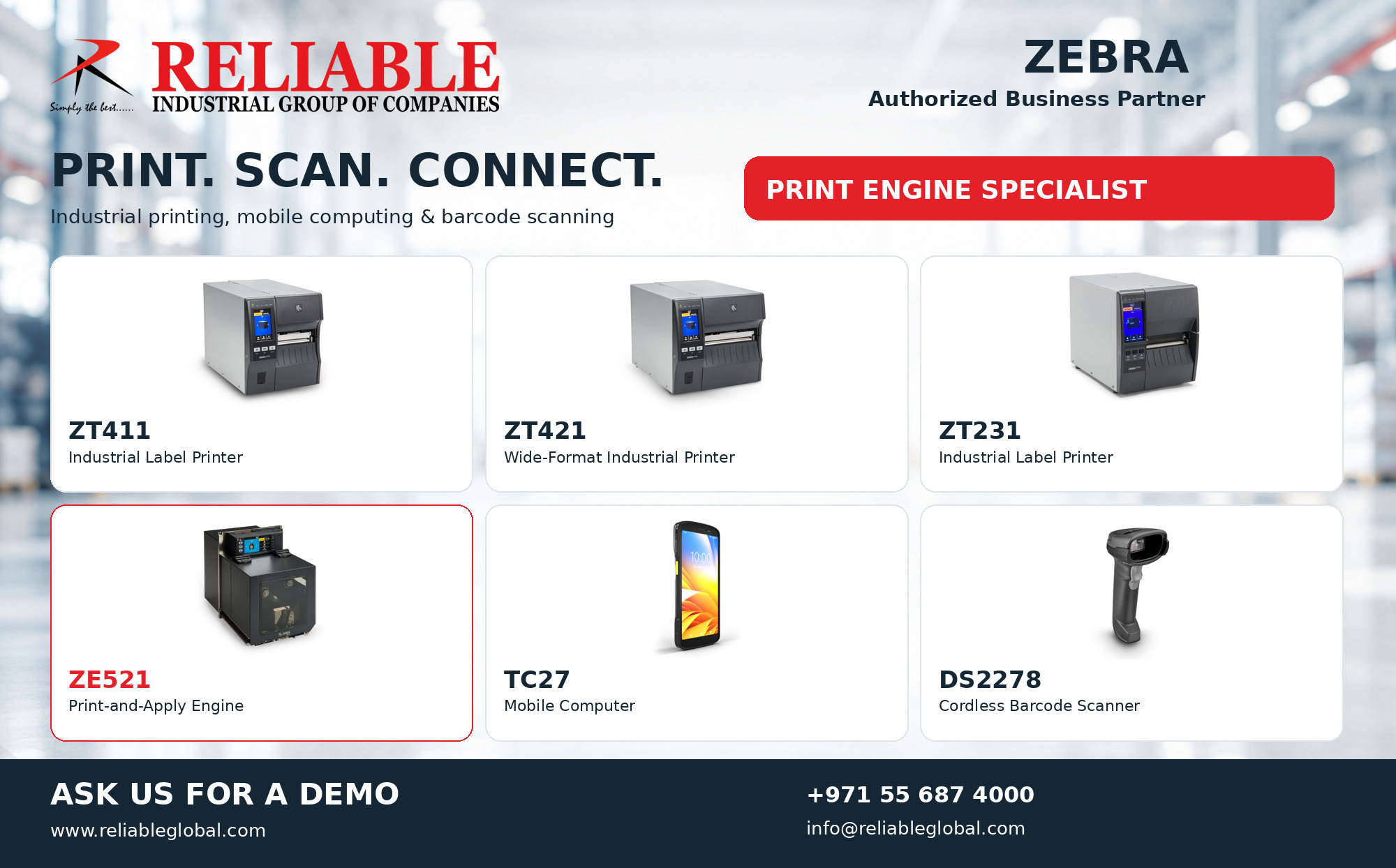
Linx 9900 Continuous Inkjet Printer in the UAE

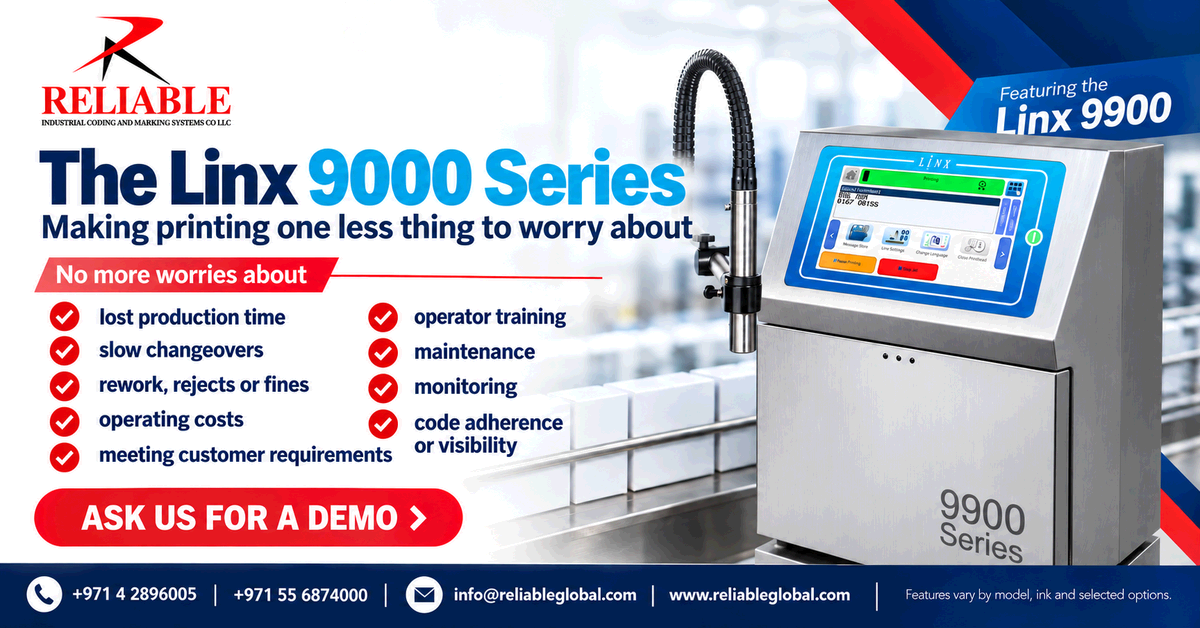
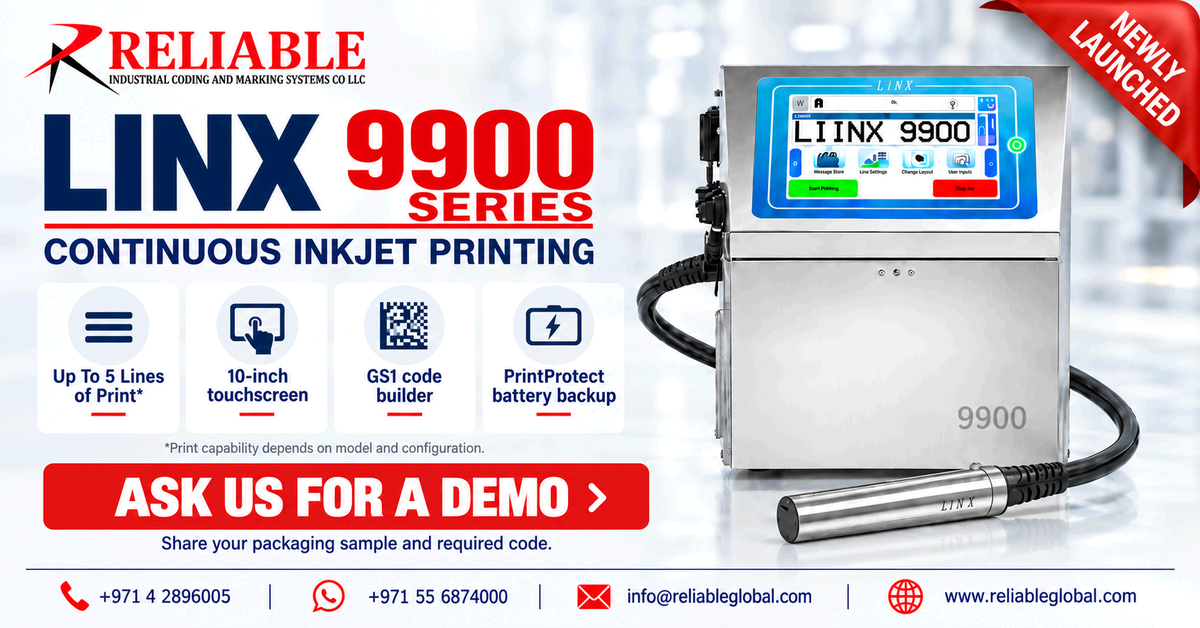
Reliable Industrial Group supplies the Linx 9900 continuous inkjet printer in the UAE for manufacturing dates, expiry dates, batch numbers and product codes. This date coding machine prints variable information directly onto suitable packaging as it moves along the line. First, we review your product and code requirements. Then, we help select the ink, printhead setup and line arrangement for your application.

Linx 9900 continuous inkjet printer marking date and batch codes on food cups
Linx 9900 for production date, expiry date and batch coding. Application illustration.

Ask for Sample Marking

What Does the Linx 9900 Print?

The printer supports up to three lines of text for everyday production coding. For example, a message can combine a manufacturing date, expiry date and batch number. It also supports symbols, logos, sequential numbers, barcodes, QR codes and Data Matrix codes within the selected print format.

In addition, the built-in GS1 code builder guides users through message creation. As a result, teams can prepare structured codes for their product identification needs. However, the final code size and readability still need checking on the actual package.

  • Manufacturing, expiry and best-before dates
  • Batch numbers, lot codes and time stamps
  • Sequential numbers and product information
  • Barcodes, Data Matrix and QR codes
  • Logos, symbols and simple graphics

Simple Operation on Busy Production Lines

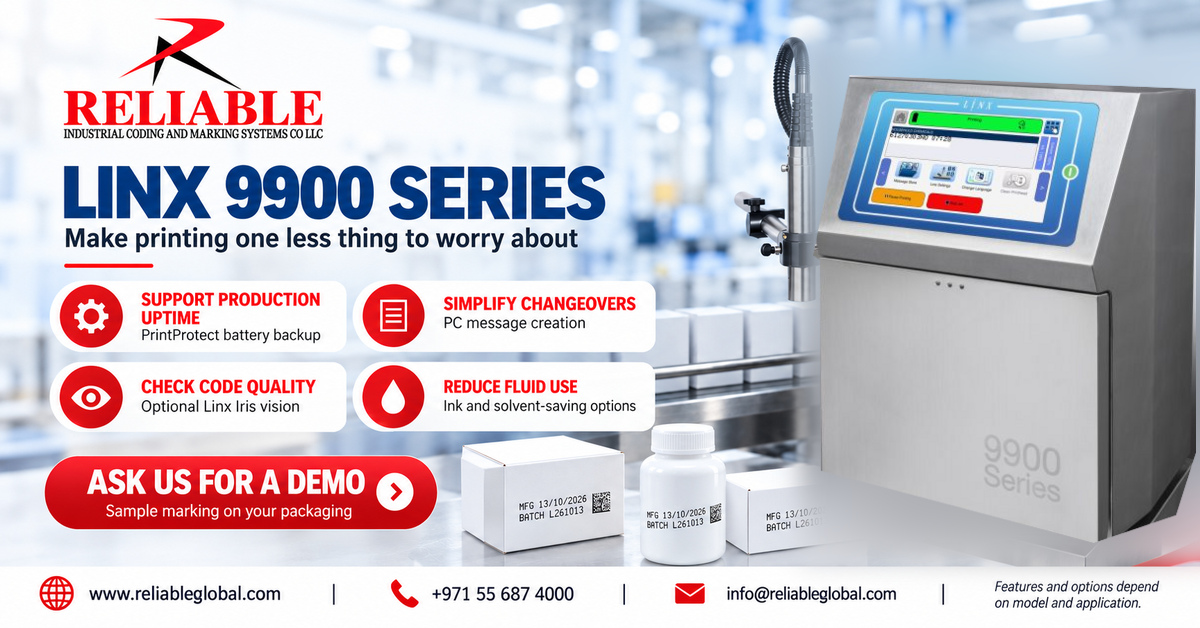
A 10-inch colour touchscreen gives operators access to messages and printer functions. For example, operators can customise the home screen with frequently used controls. Meanwhile, a supervisor lock helps manage access to settings.

The printer also provides a fluid refill warning. In addition, operators can add the correct ink and solvent cartridges while printing. As a result, routine refills can fit into the production workflow without a planned print stop.

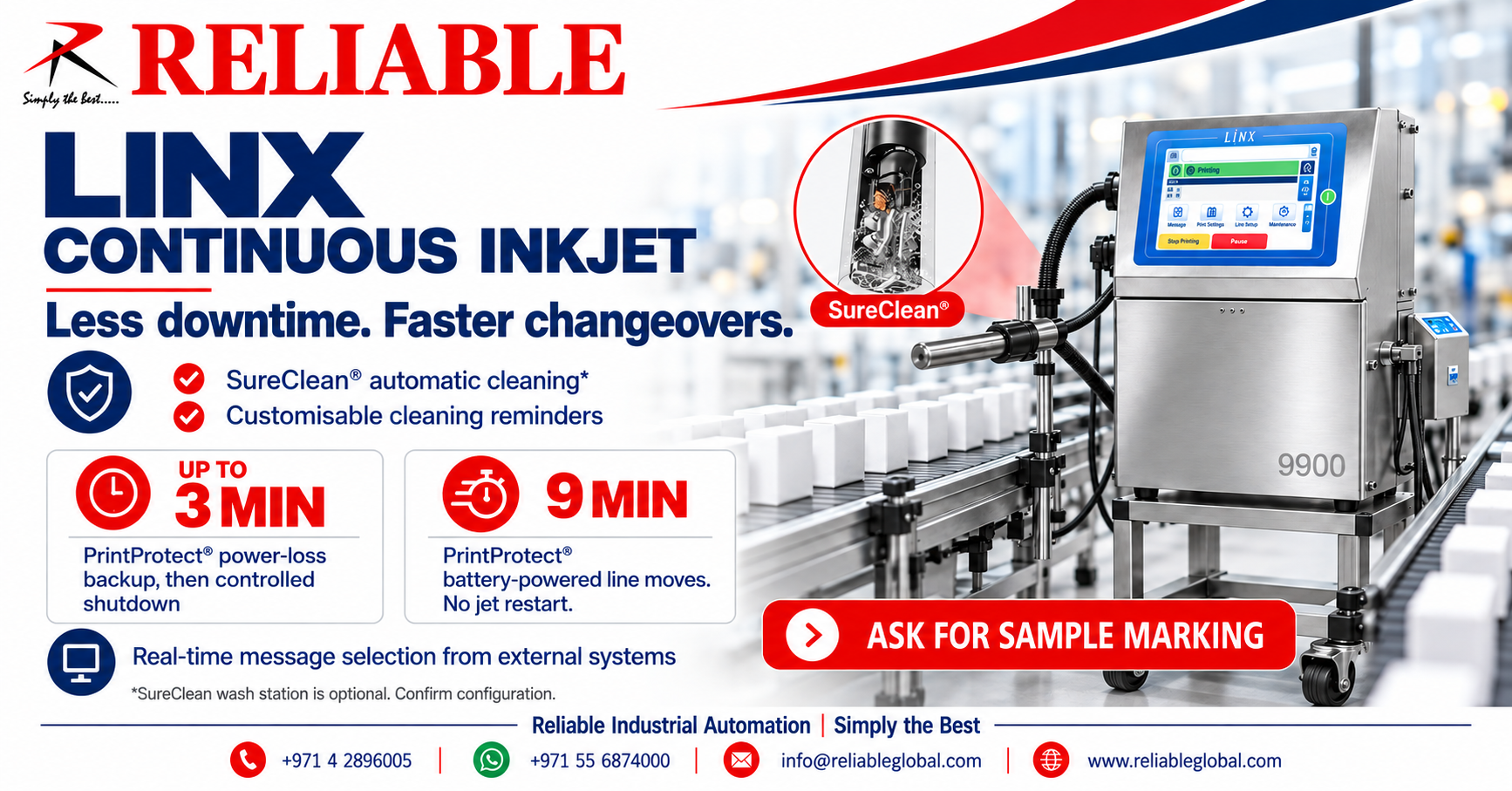
PrintProtect battery backup supports continued operation for a limited period after a power loss, followed by a controlled shutdown. In addition, customisable cleaning reminders help teams plan printhead care before print quality suffers.

Linx 9900 Features at a Glance

FeatureLinx 9900 specification
Printing technologyContinuous inkjet (CIJ)
Text linesUp to 3
Operator display10-inch full-colour touchscreen
Character height1.8 to 10.7 mm
Maximum single-line speed2.83 m/s at 5-dot character height
Maximum two-line speed1.41 m/s at 7-dot character height
GS1 code builderIncluded as standard
CabinetStainless steel, IP55 protection

These specifications apply to the base 9900 model. However, actual printing performance depends on the message, ink, printhead setup and production conditions. Therefore, we assess the required code at your working line speed before recommending a configuration.

Choosing Ink for Your Packaging

A continuous inkjet printer needs an ink that suits both the packaging surface and the production process. For example, bottles, cans, cartons and flexible packs present different adhesion and drying needs. In addition, the surface finish, moisture and handling conditions affect the result.

Sample marking lets you inspect the code on your own product. Next, you can check contrast, placement and resistance to normal handling. As a result, this practical review helps us select a date coding machine setup that fits your line.

For example, explore our expiry date printing solutions for food packaging for related applications.

Optional Tools for Coding and Inspection

You can add compatible accessories when the application needs them. In particular, the following options support cleaning, inspection and production monitoring:

  • SureClean wash station: cleans and dries the printhead through an automated cycle.
  • Iris vision system: checks printed code presence, position, characters and quality.
  • PrinterNet: provides printer health and production monitoring, with remote control functions.
  • Active Airflow Control: an available option for reducing solvent use, subject to configuration.

These options are separate from the standard printer specification. Therefore, we confirm the required accessories and their suitability in the proposal.

Linx 9900 Integration and UAE Support

Reliable Industrial Group reviews the conveyor, product spacing, printing position and available installation space. In addition, we consider the product detector, encoder and any required line communication. As a result, the proposed setup covers product handling as well as printing.

Our team can assist with equipment selection, installation, commissioning, operator training and ongoing support. For a wider view, explore our industrial coding and marking solutions or visit Linx Printing Technologies.

Frequently Asked Questions

Can the Linx 9900 print expiry dates?

Yes. It can print expiry dates, manufacturing dates, batch numbers and other variable messages. However, the ink and print format must suit your packaging and line conditions.

Does it support GS1 Data Matrix codes?

Yes. The printer includes a GS1 code builder and supports Data Matrix printing. Before printing, we check the required content, code dimensions and readability during the application review.

Are the wash station and vision system included?

SureClean and Iris are optional accessories. Therefore, ask us to include them in the quotation if your process needs automated cleaning or code inspection.

What determines print speed and code quality?

The message layout, character height, ink, printhead position and line conditions all affect the result. For this reason, sample marking should reflect the code and substrate you intend to use.

Ask for Sample Marking

Looking for a Linx 9900 continuous inkjet printer in the UAE? Send your product photograph, packaging material, required code, printing position and line speed. Next, our team will review the details and arrange a suitable sample marking trial. Then, we can recommend the printer setup and any useful accessories.

Contact us on WhatsApp for sample marking

Reliable Industrial Group
Telephone: +971 4 2896005
Mobile / WhatsApp: +971 55 6874000
Email: [email protected]
Website: www.reliableglobal.com
Reliable Industrial Automation | Simply the Best

Silo Truck Loading and Weighbridge Filling Systems in the UAE

Silo truck loading system filling a truck on a weighbridge with controlled dosing and live weight monitoring
Silo-to-truck filling and weighing: Start • Tare • Fill • Go. Concept illustration of an integrated Reliable loading solution.

Reliable Industrial Group provides silo truck loading solutions with an integrated weighbridge filling system in the UAE. First, the system records the empty truck weight. Then, it controls material flow towards the target net load. Finally, it confirms the settled weight before truck release.

Start • Tare • Fill • Go gives operators and drivers a clear sequence from arrival to dispatch. As a result, each loading cycle can link the vehicle, material, order and weight record.

Ask for a Silo Loading Proposal

Silo Truck Loading: Start, Tare, Fill, Go

  1. Start — approve the loading job. First, identify the vehicle and select the material, order and target net load. The truck stops beneath the chute with all wheels on the weighing platform. Before loading starts, the controls check the required permissions and position signals.
  2. Tare — record the empty truck weight. Next, capture a stable tare reading. This becomes the reference for the material added during filling. Therefore, the system can track the load separately from the weight of the vehicle.
  3. Fill — dose material towards the target. The controller operates the connected feeder or discharge gate while monitoring weight. Where the equipment supports it, coarse and fine feed stages help control the approach to the target. In addition, the cutoff settings can account for material still falling after the gate closes.
  4. Go — confirm the result and release the truck. Finally, stop material flow and allow the weight to settle. The system records the final gross and net weights and checks the result against the agreed limits. Once the loading equipment is clear and all release conditions are met, it can authorise the truck to leave.

How Weighbridge Filling Controls the Load

A weighbridge filling system measures the truck and its contents. The controller calculates the added material using a simple relationship:

Net material weight = Gross loaded weight − Recorded tare weight

For example, if the tare is 12,000 kg and the final gross weight is 32,000 kg, the net load is 20,000 kg. These figures illustrate the calculation; they do not specify a vehicle capacity or permitted load.

During filling, falling material and vehicle movement can affect the reading. Therefore, the final check uses a stable weight after flow stops. Good silo truck loading also depends on the material, feed rate, gate response and weighbridge condition.

Silo Truck Loading System Features

Depending on the agreed configuration, a weighbridge filling system can include:

  • Vehicle identification through RFID, ANPR or operator entry.
  • Stable tare capture and gross-to-net calculation.
  • Target weight selection and controlled material dosing.
  • Live weight and loading-status displays.
  • PLC communication with feeders, gates and loading chutes.
  • Position sensors, traffic lights and boom-barrier control.
  • Loading-area cameras and transaction-linked images.
  • Weight tickets, load records and reporting.

In addition, Reliable weighbridge software can support material and customer records. Where required, we can review data exchange with your existing business systems.

Materials and Plant Integration

Bulk loading applications can include grain, animal feed, granules, aggregates and suitable powders. However, each product needs the right feeder, chute and truck arrangement. For example, powders may need enclosed transfer and dust extraction, while coarse materials need suitable wear protection.

The installation review also covers silo outlets, platform length, vehicle height and available headroom. Furthermore, the chute arrangement must avoid transferring unwanted force to the truck during weighing. For unattended operation, explore our unmanned weighbridge solutions as part of the wider site design.

Plan Your Silo Truck Loading Project

To begin, send your material type, target load and required loading time. Also include truck dimensions, weighbridge details, silo outlet drawings and site photographs.

Next, tell us which controls and software you already use. Our team can then review the dosing equipment, weighing interface and loading sequence together. This helps define a practical scope for a new installation or an existing plant.

Frequently Asked Questions

Can We Use Our Existing Weighbridge?

Often, yes. However, we first check its capacity, condition, indicator interface and position beneath the loading point. The final design also depends on the feeder and control equipment.

Does the System Weigh the Silo or the Truck?

In this arrangement, the weighbridge measures the truck during loading. Silo weighing is a separate option for monitoring stored material. Therefore, the project can use either function or combine both where required.

When Can the Truck Leave?

The release sequence follows the final weight check and loading-equipment clearance. Only then should the controls provide an exit signal. This keeps dispatch linked to the completed loading cycle.

Discuss Your Loading Requirements

Looking for a silo truck loading system in the UAE? Share your material, target weight and site layout with Reliable Industrial Group. Together, we can review a suitable weighbridge filling system for controlled dosing and load reporting.

Discuss Your Loading Project on WhatsApp

Reliable Industrial Group
Telephone: +971 4 2896005
Mobile/WhatsApp: +971 55 6874000
Email: [email protected]
Website: www.reliableglobal.com
Reliable Industrial Automation | Simply the Best

LASER CODERS | LASER MARKING PRINTERS

Reliable laser coders and laser marking printers with Linx CSL units and packaging samples
Linx CSL laser coding solutions from Reliable Industrial Group. Ask for sample marking on your product or packaging.

Laser coders help manufacturers apply permanent product information without printing ink or ribbons. Reliable Industrial Group supplies laser marking printers in the UAE for date coding, batch identification and traceability. First, we review your packaging and production needs. Then, we help select a suitable Linx CSL configuration.

Ask for Sample Marking — send your product or packaging sample for an application review.

Laser Coders for Permanent Product Identification

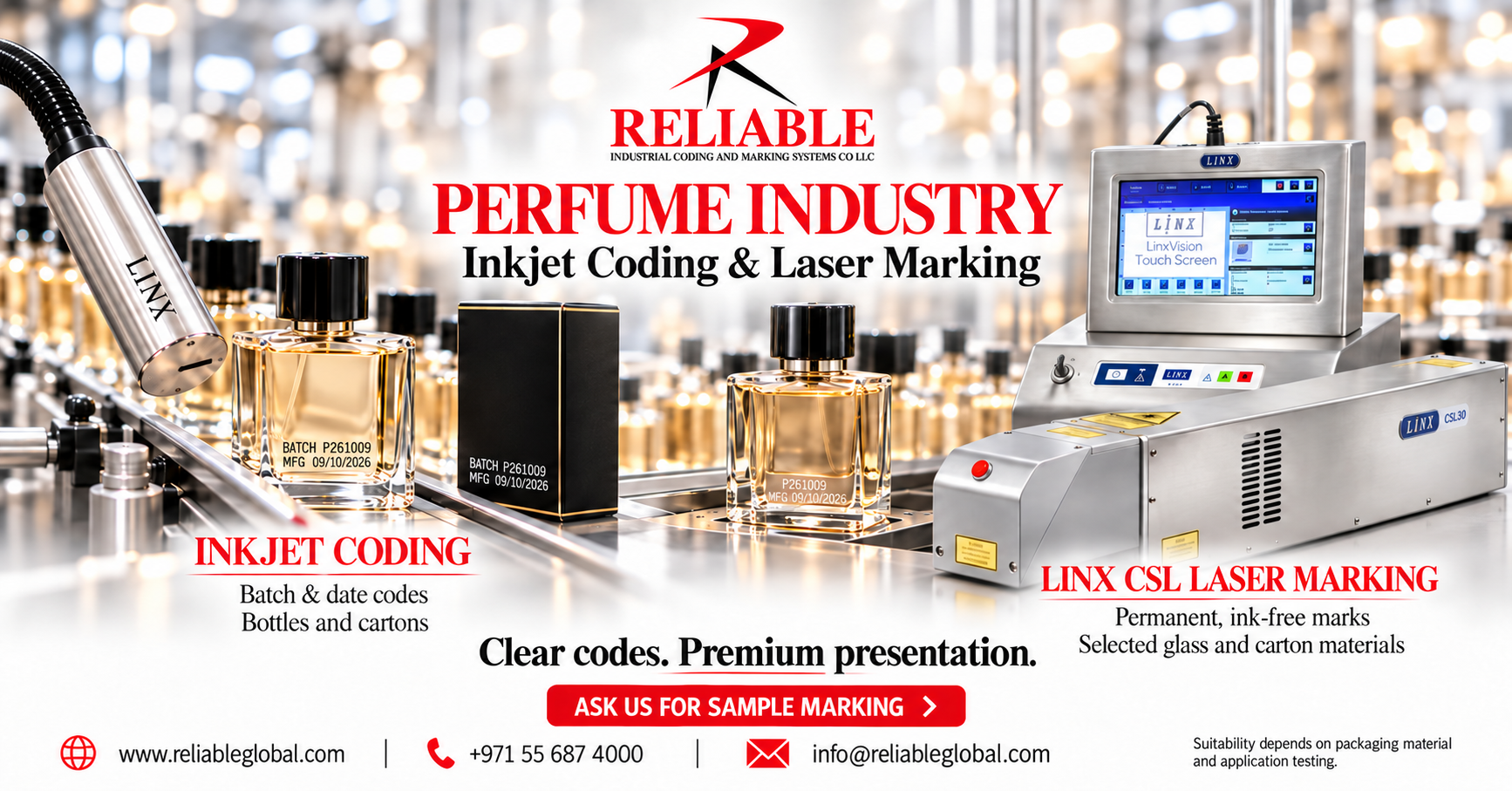
A CO2 laser uses a focused beam to change the material surface. For example, it can create a frosted mark on suitable glass or remove part of a carton coating. Because the beam changes the surface itself, the process does not apply printing ink.

Depending on the application, laser coders can mark:

  • Manufacturing, expiry and best-before dates.
  • Batch numbers, lot codes and shift details.
  • Serial numbers and variable product information.
  • Barcodes, Data Matrix and QR codes.
  • Text, graphics and logos.

In addition, the code layout can suit the available marking area. However, the final contrast and detail depend on the material and laser settings.

CSL Laser Marking Printers: 10W, 30W and 60W

The Linx CSL range includes three power classes. Therefore, choose the machine after reviewing your code, material and line speed.

Linx CSL laser coder range
ModelPower classApplication focus
CSL1010W CO2Versatile coding where sample trials confirm the required mark.
CSL3030W CO2Applications that need greater marking power or faster coding.
CSL6060W CO2Demanding materials and high-throughput production lines.

For model details, see the manufacturer’s CSL10 and CSL30 data sheet and CSL60 data sheet. However, achievable speed depends on the complete application. For example, a detailed 2D code may take longer to mark than a short date.

Materials for CO₂ Laser Coders

Typical applications include glass, PET packaging, coated cartons, rubber and selected plastics. However, each material responds differently to laser energy. For example, a change in bottle colour or carton coating may change the code contrast.

As a result, sample marking helps confirm the right wavelength, lens and settings before you choose a system. Send the actual production pack wherever possible. Also include any colour or material variants you intend to run.

Integrating Laser Coders into Your Production Line

CSL systems offer different marking heads, lenses and mounting arrangements. In addition, the LinxVision touchscreen supports message creation and operating settings. Furthermore, access controls can help limit who changes a production code.

First, review how each product reaches the marking point. Next, check the available space, product detection and line-speed signals. The installation review should also cover suitable laser guarding, interlocks and fume extraction. For this reason, include them in the installation plan from the start.

At the same time, Reliable can review your coding requirements alongside your existing packaging equipment. Explore our industrial coding and marking solutions for a wider overview.

Plan a Sample Trial on Your Packaging

Testing laser coders on your own packaging gives your team a clear result to assess. For example, you can compare the code position, contrast and appearance on your own packaging. You can also check whether the proposed text size suits your available space.

First, please share these details so we can review your application:

  • Product photographs and actual packaging samples.
  • Material type, colour, coating and pack dimensions.
  • The required code, including text and barcode examples.
  • Code size and preferred marking position.
  • Production rate, conveyor speed and product spacing.
  • Line photographs and available installation space.
  • Dust, temperature or washdown conditions at the marking point.

Then, our team can discuss a suitable machine and integration scope. If you also need automatic code reading, include the required verification method in your enquiry.

Common Questions About Operation

Does This Process Need Ink?

No. CO2 laser coders change the material surface without printing ink or ribbons. However, the complete installation still needs routine care, including attention to optics and extraction equipment.

Will One Setup Suit Every Packaging Material?

No. Material response varies, so one setup will not suit every pack. Therefore, send samples of each material and finish for review.

Can the System Mark Moving Products?

Yes, suitable CSL configurations support coding on moving production lines. However, the available marking time, code complexity and product handling determine the achievable result.

Ask for Sample Marking in the UAE

Looking for laser coders for your production line? Contact Reliable Industrial Group with your product details and required code. Then, our UAE team will help review the application and arrange the next step for sample marking.

Ask for Sample Marking on WhatsApp

Reliable Industrial Group
Telephone: +971 4 2896005
Mobile/WhatsApp: +971 55 6874000
Email: [email protected]
Website: www.reliableglobal.com
Reliable Industrial Automation | Simply the Best

Touchscreen Weighbridge Kiosk with Weight Indicator in the UAE

Reliable touchscreen weighbridge kiosk with weight indicator, RFID reader and ticket printer beside a truck scale
Reliable Industrial Group touchscreen kiosk solution for self-service weighbridge operations in the UAE.

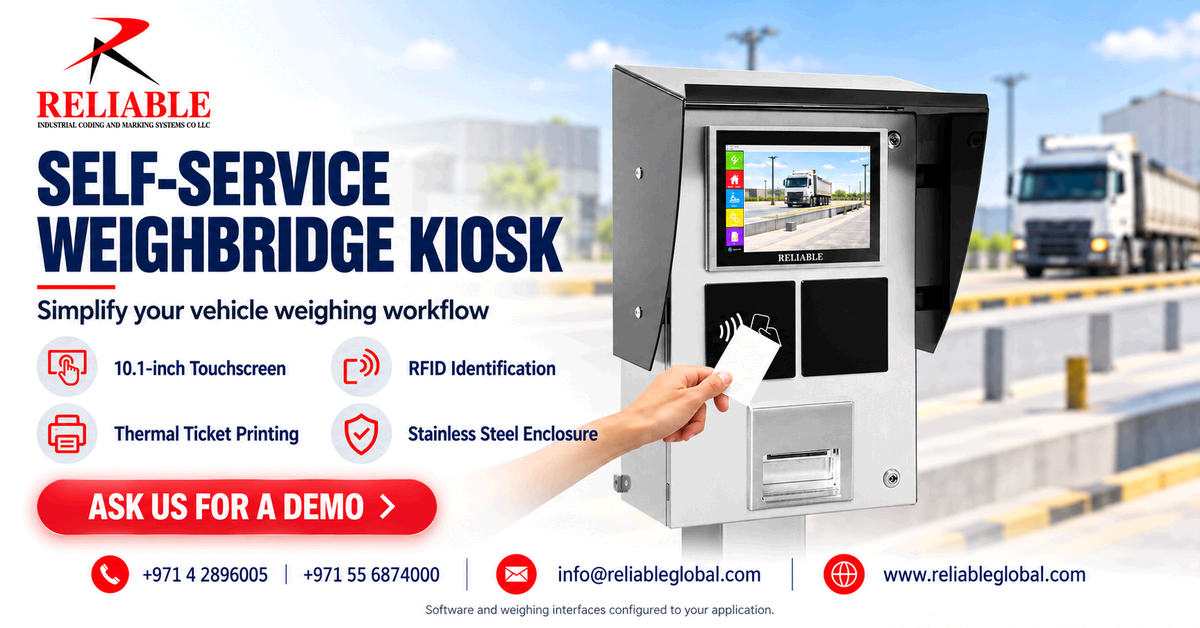
A touchscreen weighbridge kiosk gives drivers a clear point of access for self-service weighing. It brings the weighing interface, identification and ticket collection together. As a result, drivers can follow the required steps at the weighbridge instead of visiting an office for each transaction.

Reliable Industrial Group supplies and integrates kiosk solutions for weighbridge projects in the UAE. First, we review how vehicles enter, weigh and leave your site. Then, we help define a suitable kiosk, software and installation arrangement.

Request a Kiosk Solution

Touchscreen Weighbridge Kiosk Features

The featured configuration includes:

  • An 8-inch touchscreen with an integrated weight indicator.
  • An RFID reader for close-range card identification.
  • A thermal printer for weighing tickets.
  • A stainless-steel cabinet with a protective visor.
  • Column or wall mounting to suit the installation.

In addition, the display layout and ticket format can be configured for the weighing task. Therefore, confirm the required screens and ticket fields when preparing your enquiry.

How a Touchscreen Weighbridge Kiosk Supports Self-Service

A typical installation guides the driver through a defined process. For example, an RFID-based setup can use the following sequence:

  1. Identify: First, the driver presents the assigned card at the reader.
  2. Confirm: Next, the driver checks the required vehicle or job details on screen.
  3. Weigh: Then, the system records the weight once the required weighing conditions are met.
  4. Collect: Finally, the driver collects the ticket and follows the site’s exit instructions.

The final sequence depends on the software and site rules. For instance, a delivery may require a first and second weighing to determine the net load. Our weighbridge software solutions can support weight records and reporting as part of the selected system.

Clearer Driver Guidance and Transaction Records

A self-service interface can reduce repeated questions at a busy weighing point. For example, regular drivers can follow the same prompts each visit. This helps make the process more consistent.

In addition, linked vehicle and job records can reduce repeated data entry. The selected software can also organise transaction information for later review. Consequently, staff can spend more time checking exceptions and resolving incomplete records.

For a wider overview of cabinet layouts and driver access, read our outdoor weighbridge kiosk guide.

Connect Your Touchscreen Weighbridge Kiosk to Site Systems

A kiosk forms one part of the weighing installation. Therefore, the project review should include the existing scale equipment, software and communication links.

Depending on the selected configuration, our team can assess connections to cameras, vehicle records and business systems. However, these functions need suitable hardware, software and integration work. They do not come automatically with every kiosk.

For sites that need controlled vehicle movement, we can also review traffic lights and boom barriers. These can form part of a wider unmanned weighbridge system with an agreed operating sequence.

Plan the Kiosk Position and Driver Access

Before installation, check where drivers will reach the screen, reader and ticket outlet. For example, different vehicle types may need different mounting heights or access arrangements. The kiosk should also allow staff to refill paper and carry out routine service.

In addition, review sunlight, dust, rain exposure and cabinet temperature at the proposed location. This is especially useful when planning an outdoor UAE site. Therefore, confirm the mounting, protection and power arrangements during the application review.

Send Your Weighbridge Requirements

To help us select a touchscreen weighbridge kiosk, please share:

  • Site photographs and the proposed kiosk location.
  • Existing weighbridge, indicator and software details.
  • Vehicle types and expected daily transactions.
  • Required identification method and ticket fields.
  • Any camera, barrier or business-system connection needs.

If you also need a platform, explore our truck scale options. Then, discuss the kiosk and weighing equipment together so the proposal covers the full application.

Frequently Asked Questions

Can a touchscreen weighbridge kiosk work with an existing scale?

It may be possible. First, we need to review the scale, indicator and software connections. This helps confirm the scope of any upgrade or integration work.

Does a kiosk make every weighbridge fully unmanned?

No. A kiosk supports self-service, but full automation depends on the complete site setup. Therefore, review vehicle guidance, access control and exception handling as part of the project.

Request a Kiosk Solution

Planning self-service weighing in the UAE? Send Reliable Industrial Group your site details and operating requirements. Our team will help review a suitable kiosk arrangement and prepare a proposal.

Request a Kiosk Solution

Reliable Industrial Group
Telephone: +971 4 2896005
Mobile/WhatsApp: +971 55 6874000
Email: [email protected]
Website: www.reliableglobal.com
Coding and Marking on Metal in UAE | Reliable

Coding and marking on metal with inkjet and fibre laser systems for cans, pipes and parts

Coding and marking on metal helps manufacturers identify products throughout production, storage and delivery. Reliable Industrial Group supplies industrial coding solutions in the UAE for metal packaging and components. For example, we help you select equipment for dates on cans or serial numbers on parts. In each case, we match the system to your material and production line.

Our coding and marking solutions include continuous inkjet printers and fibre laser coders. First, we review your sample and the code you need. Then, we assess the surface finish, production speed and handling conditions.

Ask for Sample Marking

Applications for Coding and Marking on Metal

Metal products come in many shapes and finishes. For example, a smooth drinks can presents a different coding task from a rough cast part. Common applications include:

  • Manufacturing dates, expiry dates and batch numbers on cans and tins.
  • Product references and batch codes on pipes, tubes and profiles.
  • Serial numbers and part identification on metal components.
  • Data Matrix codes and other machine-readable identifiers where the surface and code size allow.

In each case, the mark needs enough contrast for its intended use. Therefore, we assess both human-readable text and any scanner requirements before selecting the equipment.

Continuous Inkjet Printing on Metal

Continuous inkjet, or CIJ, places small ink droplets onto the product without touching it. As a result, it offers a practical way to code moving products and many curved surfaces. For example, manufacturers use CIJ to add changing date and batch information during production.

The Linx 9000 Series, including the 9900 range, supports text and a range of barcode formats. Features vary by model, so we match the printer to the code size and line conditions. In addition, stored messages can simplify changes between products and production jobs.

Fibre Laser Coding and Marking on Metal

A fibre laser changes the metal surface to form a permanent mark. As a result, it can suit applications that need lasting part identification. In addition, it uses no printing ink or makeup solvent.

The Linx FSL20 and FSL50 fibre laser coders can produce fine text, serial numbers and detailed codes on suitable materials. Their compact marking heads also allow integration into moving or stationary production setups. However, the metal finish, marking area and available cycle time still determine the final result.

Choose the Right Ink and Surface Preparation

Bare, painted and coated metal surfaces do not all behave the same way. For example, oils, moisture and surface treatments can affect how well an ink bonds. Therefore, the ink choice forms part of the application review.

Specialist CIJ inks offer options for contrast, adhesion and demanding processes. For instance, some applications need codes that withstand heat treatment or contact with cleaning fluids. Consequently, we recommend testing the chosen ink under the actual process conditions, including any handling after printing.

Plan Coding and Marking on Metal for Your Line

First, check the code on a sample of your actual product. Next, review how the installation will place each code at the required output. To help our team assess your application, share the following details:

  • Metal type, coating and photographs of the product.
  • Sample text, barcode content and the available marking area.
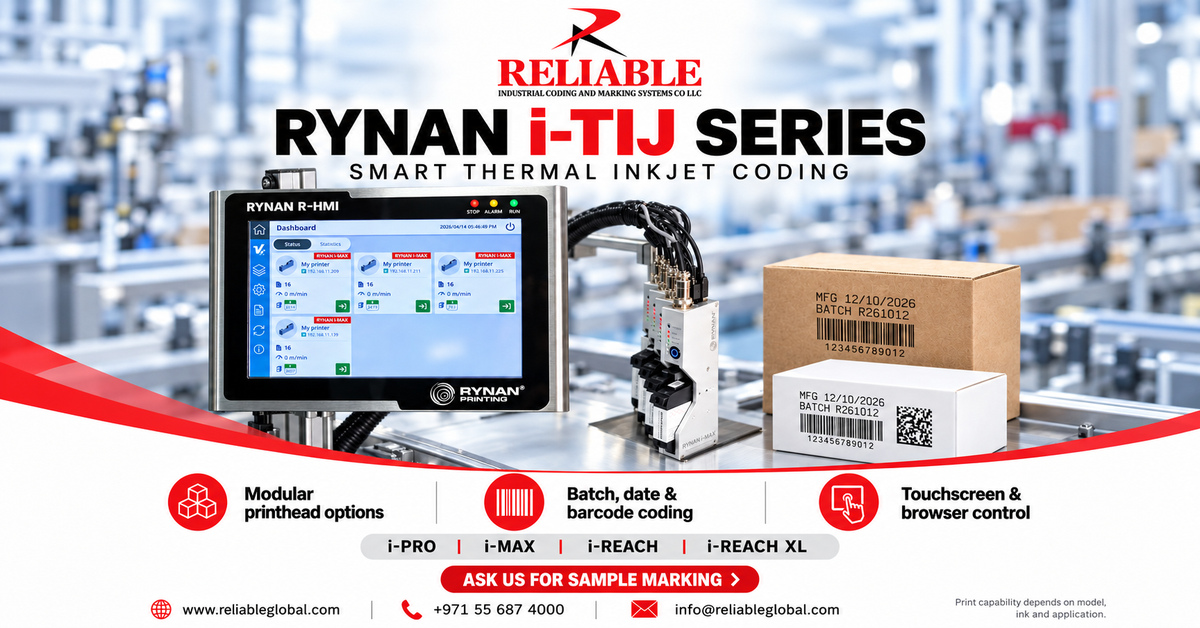
  • Products per minute or conveyor speed.
  • Product temperature and any moisture, oil or dust.
  • Required resistance to rubbing, washing, heat or outdoor storage.
  • Available line space and any code inspection or data connection needs.

Finally, discuss how operators will select messages and check the result. This helps define a practical setup for daily production.

Frequently Asked Questions

Should I choose inkjet or laser for metal coding?

The choice depends on the surface, code and durability requirements. CIJ offers flexible ink-based coding, while fibre laser marking changes the material itself. Therefore, use a sample trial to compare the results.

Can one ink work on every metal finish?

No, because coatings and process conditions affect adhesion. Therefore, choose an ink for the actual product and confirm its performance through testing.

Does a laser remove all maintenance needs?

No. Although a laser removes the need for printing ink, the installation still needs routine care. Therefore, include the marking head, optics and any extraction equipment in the service plan.

Ask for Sample Marking

Planning coding and marking on metal in the UAE? First, send Reliable Industrial Group your product photographs, required code and production speed. Then, ask our team to arrange a sample review and recommend the next step.

Ask for Sample Marking

Reliable Industrial Group
Telephone: +971 4 2896005
Mobile/WhatsApp: +971 55 6874000
Email: [email protected]
Website: www.reliableglobal.com
Filling, Capping and Labelling Solutions in the UAE

Filling capping and labelling equipment for bottles — Reliable Industrial Group.

Reliable Industrial Group supplies filling capping and labelling solutions in the UAE for manufacturers who need consistent product handling from filling to finished packaging. We help you select equipment to suit your product, container, closure and label. As a result, each stage can work towards the same production target.

From liquids and creams to bottles and jars, the right setup brings three key tasks together: accurate filling, secure capping and consistent labelling. Depending on your needs, you can choose a standalone machine or discuss an integrated production line.

Send your product details for a filling, capping and labelling proposal.

Filling Capping and Labelling Solutions for Your Products

Every application starts with the product and its packaging. For example, a thin liquid and a thick cream may need different dosing methods. Similarly, the bottle shape affects how a conveyor holds and transfers it between machines.

For this reason, our team reviews these details before recommending equipment. We also consider your required output, available space and plans for future production.

Filling Machines for Liquids, Creams and Other Products

Filling is the first stage of a filling capping and labelling line. Here, the machine doses product into its container. First, we review the fill volume, product flow and filling temperature. We then consider factors such as foam, particles and the need to limit drips.

  • Liquid filling for suitable beverages, oils and other fluid products
  • Cream and viscous-product dosing for suitable food and personal-care applications
  • Dedicated dosing options for powders and granules
  • Bench-top, semi-automatic and automatic configurations, depending on the application

However, one filler does not suit every product. Therefore, sample trials help confirm the dosing method and achievable output before you commit to a configuration.

Capping Machines for Bottles and Jars

After filling, the capping stage applies or tightens the closure. The correct machine depends on the cap design, container shape and required production speed. Therefore, both cap and container samples form an important part of machine selection.

Available equipment categories include screw-cap, twist-off, pressure-cap, ROPP and trigger-capping systems. For example, a trigger closure needs handling that suits its shape. In addition, the proposed setup should account for cap feeding and container stability.

Labelling Machines for Consistent Presentation

Labelling completes the filling capping and labelling process by adding product information and brand identity to the container. For example, a wrap-around system may suit round bottles and jars. Alternatively, shaped containers may need front-and-back or other multi-side application.

  • Wrap-around labels for suitable cylindrical containers
  • Front-and-back or double-side labels
  • Top-and-bottom label application
  • Three-side labelling and print-and-apply options

To select the right system, we review the label size, material, position and container surface. In addition, we check the label-roll arrangement and product spacing.

Integrating Filling Capping and Labelling Equipment

An integrated line needs more than three individual machines. First, the conveyor must transfer containers smoothly. Next, the filling and capping stages must match the planned flow. Finally, the labelling station must receive products at a suitable spacing and orientation.

Reliable Industrial Group can review your existing equipment and discuss the required controls and interfaces. You can also explore our complete production line solutions for the wider process.

Where the application requires batch or expiry information, consider a suitable coding and marking solution. In addition, an automatic checkweigher can provide a separate weight-inspection stage.

How to Select Filling Capping and Labelling Solutions

To plan your filling capping and labelling setup, send the following details:

  • Product description, filling temperature and any foam or particles
  • Required fill volumes and production rate for each container size
  • Container photographs, dimensions and material
  • Cap photographs, dimensions and closure type
  • Label artwork, dimensions, roll details and application position
  • Available floor space, conveyor height and line direction
  • Cleaning requirements and available utilities

Actual output depends on the product, container and selected configuration. Consequently, sample testing and agreed acceptance trials help establish realistic performance targets.

Frequently Asked Questions

Can I start with one machine and expand later?

Yes, standalone equipment may suit an initial requirement. However, discuss future integration early so the layout and controls can support your plans.

Can one line handle several bottle sizes?

Depending on the selected machines, change parts and settings may support several formats. Therefore, provide samples of every planned bottle, cap and label.

Can you add filling capping and labelling to an existing line?

First, our team reviews the available space, product flow and control requirements. After that review, we can propose a suitable integration scope.

Request a Proposal from Reliable Industrial Group

Discuss your filling capping and labelling requirements with our UAE team. Send product photographs and your target output so we can help you select a practical configuration.

Reliable Industrial Group
Telephone: +971 4 2896005
Mobile/WhatsApp: +971 55 6874000
Email: [email protected]
Website: www.reliableglobal.com
Industrial Automation for a Brighter Tomorrow

Equipment category references: filling equipment, capping equipment and labelling equipment.

Checkweigher and Metal Detector Solutions in the UAE

Integrated checkweigher and metal detector system in UAE with separate rejection

A checkweigher and metal detector checks pack weight and finds metal in products as they move along a production line. Reliable Industrial Group supplies these systems in the UAE for food, drinks, medicines, cosmetics and industrial goods. Together, these two checks help teams control quality before packs leave the factory.

Each line has different needs. Therefore, we review your product, pack size and line speed before choosing the system. We also check the space, cleaning needs and reject method so the equipment suits your site.

Why Choose a Checkweigher and Metal Detector?

A checkweigher measures each pack in motion and compares its weight with the set limits. As a result, your team can find packs that are too light or too heavy. This helps reduce excess filling and spot changes in the filling process.

Meanwhile, the metal detector checks for ferrous, non-ferrous and stainless-steel contaminants. When it finds a metal fragment within its tested detection limits, the system sends that pack to a reject bin. Together, these checks support product quality and help reduce the risk of faulty packs reaching customers.

Checkweigher and Metal Detector: How the Line Works

In the layout shown, products travel through four stages:

  1. Metal detection: Packs pass through the detector opening.
  2. Metal rejection: The next station removes packs flagged by the detector.
  3. Weight check: Accepted packs move onto a separate weighing belt.
  4. Weight rejection: A final station removes packs outside the weight limits.

Because each reject station follows its own check, the two types of rejected packs stay separate. The weighing belt also remains clear of the pushers. This layout helps staff find the cause of a rejection and follow the correct handling process.

Weight Control and Metal Detection Benefits

A combined checkweigher and metal detector can save line space while giving staff one point to monitor both checks. In addition, weight data helps teams spot trends and adjust filling settings.

  • Check each pack against set weight limits
  • Detect metal within the agreed test limits
  • Keep weight rejects separate from metal rejects
  • Reduce excess filling and avoidable waste
  • Track results and review batch quality
  • Fit inspection into the existing production line

For example, repeated low-weight packs may point to a filling issue. However, a metal alert needs a separate review of the product and process. Clear reject records help staff respond to each issue.

Checkweigher and Metal Detector Applications

These systems can inspect bags, trays, cartons, bottles and other packs. For example, common uses include bread, snacks, pasta, sweets and boxed products. They can also suit medicine packs, personal-care goods and selected industrial parts.

However, the product and its wrapper affect metal detection. Wet or salty foods and metal-based films may need a different detector setup. Therefore, sample tests help confirm the right choice and the detection limits for your packs.

Reject Systems and Line Controls

Your checkweigher and metal detector needs a reject method suited to the pack. Options include pushers, air jets, diverters and drop sections. For instance, a light pouch may need a different method from a heavy carton.

In addition, available controls can check air pressure, confirm that a pack was rejected and warn when a bin is full. Lockable bins and alarms can also help staff manage rejected goods. We select these options based on the line and your quality procedures.

Choosing Your Checkweigher and Metal Detector

First, send the lowest and highest pack weights, plus the pack length, width and height. Next, tell us the number of packs per minute, belt height, travel direction and available space. Photos of the line will also help us plan the fit.

We need to know the product type, wrapper material and target metal test sizes. In addition, please share your cleaning method, power supply and compressed-air supply. These details help us choose the detector opening, belts and reject units.

Performance depends on the pack, speed and site conditions. Therefore, we confirm weight accuracy and metal sensitivity for the selected setup rather than applying one figure to every product.

UAE Installation and Support

Reliable Industrial Group can help with equipment selection, line setup, installation, start-up and staff training. After installation, clear operating steps and routine tests help your team check ongoing performance.

You can also explore our industrial weighing equipment and coding and marking solutions. For more equipment details, see the combined inspection system reference.

Checkweigher and Metal Detector FAQs

Can the system remove metal and weight rejects separately?

Yes, the shown layout uses two reject stations and two bins. As a result, metal rejects stay apart from packs that fail the weight check.

Can all packaging pass through a metal detector?

Not every pack suits the same detector. For example, foil and some metal-based films affect detection, so we review the wrapper and test samples before selection.

Does a checkweigher and metal detector need routine tests?

Yes. Staff should follow the agreed weight checks, metal test-piece checks and reject checks. In addition, records help confirm that the system works as intended over time.

Can the system fit a wet production area?

Protected models and options are available. However, the machine’s protection rating and cleaning limits must match the site’s wash process.

Request a Quotation

Contact Reliable Industrial Group for a checkweigher and metal detector suited to your UAE production line. Send your pack details and target speed so we can review the right setup for you.

Telephone: +971 4 2896005
Mobile/WhatsApp: +971 55 6874000
Email: [email protected]
Website: www.reliableglobal.com
Printing on Flexible Plastics in the UAE

Printing on flexible plastics with Linx coding equipment for pouches, sachets and flow-wrap packaging

Clear, durable and high-speed coding for pouches, sachets, flow wrap, films and flexible packaging.

Printing on flexible plastics requires a coding system that can produce clear, durable information on smooth, glossy and lightweight packaging materials. Reliable Industrial Group supplies industrial coding solutions for food, beverage, pharmaceutical, cosmetics, personal-care and consumer-product manufacturers throughout the UAE.

Flexible films can stretch, move quickly and pass over rollers immediately after printing. Therefore, the selected printer must apply the code in the correct position and allow it to dry before the film contacts guides or other machine parts. In addition, the ink, ribbon or laser technology must suit the exact film structure and production environment.

Our team reviews the packaging material, machine type, line speed, code content and available mounting space before recommending a solution. As a result, customers receive a practical system designed for their actual product and production process.

Printing on Flexible Plastics for Different Packaging Formats

Flexible packaging appears in many forms and materials. Common examples include polypropylene flow wrap, polyethylene bags, laminated pouches, sachets, vacuum packs, shrink film and lidding film. Each format creates different requirements for print position, adhesion and code durability.

Manufacturers commonly print:

  • Manufacturing and packing dates
  • Expiry and best-before dates
  • Batch and lot numbers
  • Production time and line identification
  • Product codes and variable information
  • Barcodes, QR codes and Data Matrix codes
  • Logos, symbols and handling information
  • Traceability and regulatory details

A correctly integrated film printer can apply this information before forming, during packaging or after sealing. Consequently, manufacturers can select the most stable coding stage for their packaging machine and product.

Flow-Wrap Film Coding

Flow wrapping is widely used for snack foods, confectionery, bakery products, household items and consumer goods. The packaging machine pulls printed or transparent film around the product and seals it at both ends. Because the film moves continuously and may pass over rollers immediately after coding, fast drying and accurate print triggering are essential.

Continuous inkjet technology can apply compact date and batch codes without touching the film. Meanwhile, thermal transfer overprinting can create high-resolution text, graphics and machine-readable codes before the package forms. The best option depends on the required print area, machine configuration and production speed.

Printing on Flexible Plastics for Pouches and Sachets

Stand-up pouches, pillow packs and sachets provide convenient packaging for powders, liquids, snacks, spices, sauces, pet food and personal-care products. However, their flexible surfaces, seams and folds can affect code placement.

A continuous inkjet printer can code a filled pouch as it travels along a conveyor. Alternatively, a thermal transfer printer can mark the flat film before filling and sealing. Therefore, producers can choose an arrangement that protects the code from folds, seals and product contact.

For reliable results, the coder should print on a stable area with sufficient contrast. The product guide, sensor and mounting bracket must also keep the distance between the printhead and package consistent.

Vacuum-Pack and Lidding-Film Coding

Fresh meat, cheese, ready meals and other chilled products often use vacuum films or sealed trays. These packs may contain moisture, oils or condensation, so ordinary inks may smear or lose adhesion.

Specialist inks can provide better resistance to handling and light surface contamination. In addition, thermal transfer ribbons can create durable high-resolution information on suitable lidding materials before sealing. Careful sample testing helps confirm that the code remains readable through packing, storage and distribution.

Technologies for Printing on Flexible Plastics

Continuous Inkjet Printing

Continuous inkjet, also called CIJ, applies small ink droplets without touching the moving package. It can print date codes, batch numbers and variable data on filled packs, formed pouches and continuously moving film.

The Linx 9000 Series offers flexible printhead mounting and inks developed for fast drying and strong adhesion. Moreover, suitable configurations can operate in hot, dusty, humid or wet production areas. This makes CIJ a practical choice for many high-speed applications involving printing on flexible plastics.

Thermal Transfer Overprinting

Thermal transfer overprinting, or TTO, transfers ink from a ribbon onto flat flexible film. It produces high-resolution text, barcodes, ingredients and graphics. Because the code dries instantly, TTO can support packaging films that move directly into forming and sealing sections.

TTO systems can suit intermittent and continuous packaging machines. They are commonly installed on vertical form-fill-seal, horizontal form-fill-seal and labelling equipment. Different printhead widths and ribbon colours allow manufacturers to match the print area and required contrast.

Laser Coding

Laser coders can create permanent marks without ink or ribbon when the film structure is suitable. UV laser technology applies low thermal stress and can produce clean, high-contrast marks on selected thin plastic films. As a result, it reduces the risk of melting or deforming delicate material compared with unsuitable heat-based marking methods.

However, laser suitability depends on the plastic composition, colour, coating and required production speed. It also needs appropriate guarding and fume extraction. Therefore, product testing is necessary before confirming a laser system.

Challenges in Flexible Film Printing

Ink Adhesion on Smooth Films

Polyethylene, polypropylene and laminated films can have low surface energy. Consequently, standard ink may rub off or fail a tape test. High-adhesion inks designed for flexible plastics can improve resistance to handling, abrasion and some oils.

Fast and Variable Production Speeds

Form-fill-seal machines may run continuously, intermittently or at changing speeds. Therefore, the coding system must synchronise with the film movement. Sensors, encoders and correct printer settings help maintain code spacing and position.

Film Stretching and Code Distortion

Film tension, forming and heat sealing can move or distort a printed message. For this reason, the code should be positioned away from seals, folds and heavily stretched areas. Testing the complete package, rather than only a flat film sample, produces a more reliable result.

Cold or Demanding Environments

Chilled-food operations can expose printers and packaging to rapid temperature changes. Furthermore, washdown, humidity, dust and airborne oil can affect equipment and code quality. A suitable enclosure or printer protection rating can support reliable operation in these conditions.

Benefits of Reliable Flexible Packaging Coding

  • Clear identification: Apply readable date, batch and traceability information.
  • Fast production: Support high-speed continuous and intermittent lines.
  • Strong adhesion: Select inks or ribbons for glossy and low-energy films.
  • Accurate placement: Synchronise printing with product or film movement.
  • Flexible formats: Code pouches, sachets, flow wrap and vacuum packs.
  • High-resolution options: Print barcodes, Data Matrix codes and graphics.
  • Quick changeovers: Store messages for different products and pack sizes.
  • Production integration: Connect coding with packaging and control systems.

How to Select a Printer for Flexible Plastic Film

First, identify the exact film material, such as PE, PP, PVC, PET or a multilayer laminate. Next, confirm whether printing will occur on flat film, during forming or after the pack has been sealed. You should also specify whether the surface may contain moisture, oil or product residue.

Then provide the required message, print size, code colour and maximum line speed. The packaging machine type, film direction and available mounting area are also important. Finally, explain whether you need barcodes, 2D codes, automatic message selection, printer monitoring or integration with vision inspection.

These details allow our engineers to recommend the right solution for printing on flexible plastics. Product samples and videos of the packaging line can also help us confirm code quality and installation requirements.

Installation and Integration in the UAE

Good print quality depends on the complete installation. The printer needs a rigid mount, correct printhead distance and reliable product detection. In addition, cables and conduits should remain clear of moving film, rollers and sealing parts.

Reliable Industrial Group supports customers in Dubai, Abu Dhabi, Sharjah and across the UAE with selection, sample testing, installation, commissioning and operator training. We can also configure date calculations, batch formats and controlled message selection.

Explore our complete coding and marking solutions for products and packaging. You can also contact our UAE coding specialists to discuss your application.

Why Choose Reliable Industrial Group?

Reliable Industrial Group provides more than a standalone printer. Our scope can include the coding equipment, mounting bracket, sensor, encoder, beacon, protective enclosure and production-line integration. Therefore, customers receive a complete system matched to their packaging process.

Whether you need simple expiry dates on snack packs or high-resolution 2D codes on pouches, we can help you select a dependable solution for printing on flexible plastics.

Frequently Asked Questions

Which flexible packaging materials can be coded?

Industrial printers can code many PE, PP, PVC, PET and laminated films. However, adhesion and contrast vary, so sample testing is recommended.

Can expiry dates be printed on filled pouches?

Yes. A CIJ printer can apply date and batch codes as filled pouches move along a conveyor. The package should remain stable at the coding point.

What is the best technology for flow wrap?

CIJ suits compact date and batch codes, while TTO suits high-resolution text, barcodes and graphics. The correct choice depends on the machine, film and required code.

Can the code resist oil or moisture?

Specialist high-adhesion inks can resist light oil contamination, rubbing and demanding handling. Nevertheless, testing with the actual product remains important.

Can the system print QR or Data Matrix codes?

Yes. Suitable CIJ, TTO and laser systems can print machine-readable codes. The required resolution and verification standard will determine the best technology.

What information is required for a quotation?

Please provide the film material, package dimensions, code content, line speed, machine type and desired print location. Product samples and production videos are also helpful.

Request a Flexible Plastic Printing Solution

Contact Reliable Industrial Group for a practical assessment of your flexible packaging application. Our team can recommend the appropriate Linx printer, ink or ribbon and integration arrangement for your production line.

Telephone: +971 4 2896005
Mobile/WhatsApp: +971 55 6874000
Email: [email protected]
Website: www.reliableglobal.com
Can Coding Machine Solutions in the UAE

Can coding machine in UAE printing expiry dates and batch codes on beverage cans and food tins

Can Coding Machine Solutions in the UAE

Reliable, high-speed coding for aluminium beverage cans, steel food tins and metal containers.

A can coding machine applies manufacturing dates, expiry dates, batch numbers and traceability information directly onto metal cans during production. Reliable Industrial Group supplies industrial can coding solutions for food, beverage, cosmetics, personal-care and chemical manufacturers across the UAE. Our systems deliver clear, durable codes on aluminium, steel, coated and lacquered can surfaces.

Because canning lines often operate at high speed, the coding system must print consistently without slowing production. In addition, the printed code may need to withstand condensation, handling, pasteurisation, retort sterilisation or exposure to oils and cleaning chemicals. Therefore, our team reviews the can material, line speed, code position and production conditions before recommending the correct printer, ink and mounting arrangement.

Can Coding Machine Applications

Manufacturers use can coders to print variable information that supports product identification, stock control and regulatory compliance. Depending on the application, the system can print one or several lines of text as well as machine-readable codes.

  • Manufacturing and production dates
  • Expiry and best-before dates
  • Batch and lot numbers
  • Product and factory identification
  • Shift, line and time information
  • Serial numbers and variable data
  • Barcodes, QR codes and Data Matrix codes
  • GS1-compatible traceability information

A properly integrated can coding machine can apply these details to the top, bottom or side of a can. As a result, manufacturers can select a coding position that remains readable while fitting the available space on the production line.

Expiry Date and Batch Coding on Beverage Cans

Aluminium beverage cans present several coding challenges. Their surfaces are curved, reflective and non-porous. Moreover, condensation may form after cold filling, while sugary or saline residues can affect ordinary ink adhesion. A high-speed beverage line also needs rapid printing with accurate code placement.

Continuous inkjet technology can print without touching the moving can. Therefore, it suits soft drinks, energy drinks, juices, malt beverages and other canned products. Specialist inks can improve adhesion and contrast on bare, painted or coated aluminium. Meanwhile, flexible message storage allows operators to change date formats, batch details and customer-specific codes during product changeovers.

Can Coding Machine for Food Tins

Steel food cans and tins often pass through cooking, pasteurisation or retort sterilisation after coding. Consequently, the selected code must survive heat, steam, pressure and cooling cycles while remaining legible throughout distribution.

Specialist retort inks can produce durable codes for demanding food-processing conditions. Thermochromic inks can also change colour after exposure to a specified temperature, providing a visible process indication. However, the correct ink depends on the metal coating, processing method and required code colour. For that reason, product-sample testing remains an important part of printer selection.

Continuous Inkjet Coding with the Linx 9900 Series

The Linx 9900 Series provides a flexible continuous inkjet solution for demanding production environments. It can print multiple lines of text as well as variable information, Data Matrix and QR codes. Furthermore, compact printhead options support narrow coding areas and curved can surfaces.

Manufacturers can install the printhead in different orientations to code the base, lid or side of the container. In addition, suitable configurations support wet, dusty, hot or non-temperature-controlled areas. This flexibility makes the system suitable for high-volume can production as well as lines that handle several can sizes and product variants.

A Linx can coding machine can store multiple messages and job settings. Therefore, operators can switch between products more efficiently while reducing manual data-entry errors. Optional status monitoring, alarm beacons and line integration can also help production teams respond quickly to printer warnings.

Laser Marking for Permanent Can Codes

Laser coders offer permanent, consumable-free marking for suitable bare or coated metal surfaces. They can create fine text, logos, serial numbers and 2D codes in a compact area. Because the laser changes the product surface or coating, the resulting mark cannot be rubbed or washed away like conventional ink.

However, laser suitability depends on the can material, coating, colour, line speed and required contrast. It also requires the correct guarding and fume-extraction arrangement. Therefore, our engineers recommend sample testing before confirming a laser configuration.

Challenges When Coding Steel and Aluminium Cans

Curved and Limited Print Areas

Curved sides and domed can bottoms can distort text or machine-readable codes. As a result, the printer needs accurate product guidance, suitable character dimensions and a stable printhead position. Narrow fonts and compact message layouts can improve readability where space is limited.

Moisture and Condensation

Cold filling and cooling processes can create water on the can surface. Therefore, ink selection and print position must account for moisture. A suitable high-adhesion ink can help prevent smudging and maintain code quality.

High Production Speeds

Canning lines can process large volumes every hour. Consequently, even a small coding problem can create significant rework or waste. Reliable print triggering, stable can spacing and correct encoder settings help maintain consistent code placement at speed.

Retort and Sterilisation

Food tins may face high temperatures, steam and pressure. Thus, the chosen code must withstand the entire process. Retort-resistant or thermochromic inks may provide the required durability, depending on the application.

Benefits of an Industrial Can Coding Machine

  • Clear traceability: Print accurate batch, date and production information.
  • High-speed operation: Code moving cans without direct contact.
  • Flexible positioning: Print on the base, lid or side of the can.
  • Durable codes: Select inks for condensation, retort, oils and handling.
  • Multiple messages: Store product-specific formats for quicker changeovers.
  • 2D coding: Add QR or Data Matrix codes for advanced traceability.
  • Production integration: Synchronise coding with conveyors and line controls.
  • Reduced errors: Use controlled message selection and automated date functions.

How to Select the Right Can Coding Machine

First, identify whether the container uses aluminium, steel, paint, lacquer or another coating. Next, confirm the required code content, character height, colour and position. You should also provide the maximum production speed, can dimensions and conveyor arrangement.

In addition, explain whether the cans will be cold-filled, washed, pasteurised, cooked or retorted. These conditions affect ink selection and code durability. Finally, confirm whether the production line needs automatic message selection, an encoder, a product sensor, a beacon, remote monitoring or integration with inspection and rejection equipment.

These details help our team choose a can coding machine that matches both current production and future product changes. Product samples and photographs of the proposed coding location can make the evaluation more accurate.

Installation and Support Across the UAE

Correct installation is essential for consistent can coding. Our team can review the conveyor, confirm the printhead direction, select mounting hardware and position the sensor so each code appears in the intended location. We can also configure messages, date calculations, batch formats and operator access.

Reliable Industrial Group supports customers in Dubai, Abu Dhabi, Sharjah and across the UAE with equipment selection, installation, commissioning, training and after-sales service. In addition, we can review existing coding stations that need better print quality, improved message control or a more suitable ink.

Why Choose Reliable Industrial Group for Can Coding?

Reliable Industrial Group combines industrial coding experience with local UAE support. We supply complete solutions rather than only a standalone printer. Therefore, our scope can include the coder, printhead mount, sensor, encoder, beacon, protective cabinet, line integration and operator training.

Whether you need expiry dates on beverage cans, batch codes on food tins or permanent traceability marks on coated metal, explore our complete coding and marking solutions. We can help you select and integrate the right can coding machine for your production line.

Frequently Asked Questions

What information can be printed on cans?

You can print manufacturing dates, expiry dates, batch numbers, production times, line identifiers, serial numbers, barcodes, QR codes and Data Matrix codes.

Can the printer code aluminium and steel cans?

Yes. Industrial continuous inkjet and laser systems can code aluminium, steel, coated and lacquered cans. However, the correct technology and ink depend on the exact surface and production process.

Can codes withstand condensation and retort?

Yes, suitable specialist inks can maintain legibility in wet conditions and after retort or pasteurisation. Sample testing helps confirm the correct ink for the product.

Where can the code be placed?

A can coding machine can normally print on the base, lid or side when the conveyor, printhead mount and product guidance support that position.

Can one printer manage several products?

Yes. Modern coders can store multiple messages and job settings. As a result, operators can switch between can sizes, brands and date formats more quickly.

What details are required for a quotation?

Please provide the can material and size, code content, desired code location, line speed, production environment and any post-coding process. Product samples, videos and line photographs are also helpful.

Request a Can Coding Machine Quotation

Contact Reliable Industrial Group for a practical coding solution for beverage cans, food tins and industrial metal containers. Our specialists can review your samples, production speed and traceability requirements before recommending the appropriate Linx coding technology.

Telephone: +971 4 2896005
Mobile/WhatsApp: +971 55 6874000
Email: [email protected]
Website: www.reliableglobal.com
Complete Production Line Solutions in the UAE

Complete production line solutions in UAE from weighing and filling to pallet wrapping

Complete Production Line Solutions in the UAE

Reliable Industrial Group supplies complete production line solutions in the UAE for manufacturers that need accurate weighing, filling, capping, labelling, expiry date coding, shrink wrapping and pallet wrapping. Because every stage works as part of one connected process, customers can improve productivity, maintain consistent pack quality and simplify production control.

From a standalone machine to a fully integrated line, our team helps you select equipment that matches your product, container, production speed and available floor space. In addition, we support line planning, installation, commissioning, operator training and after-sales service across the UAE.

A Complete Packaging Process from Start to Finish

A successful production line must move products smoothly between each operation. Therefore, we review the complete process instead of treating every machine as an isolated purchase. The typical production sequence includes:

  1. Weighing for accurate product or ingredient measurement
  2. Filling containers with the required quantity
  3. Capping and closing bottles, jars or containers
  4. Labelling products with attractive and accurate labels
  5. Expiry date coding and marking for traceability
  6. Shrink wrapping individual products or multipacks
  7. Pallet wrapping finished loads for storage and transport

As a result, the finished line can take a product from initial measurement to a protected pallet ready for dispatch.

Seven Stages of Our Complete Production Line Solutions

1. Industrial Weighing Systems

Accurate weighing creates the foundation for consistent production. Depending on the application, manufacturers may need tabletop scales, platform scales, floor scales, tank weighing systems, load cells or automated dosing equipment. For example, a food producer may weigh ingredients before mixing, while a warehouse may verify the weight of finished cartons or pallets.

We help customers choose the correct capacity, readability, platform size and construction. Moreover, suitable indicators can connect to printers, computers, PLCs or production software for better records and traceability.

2. Filling Machines

After weighing or product preparation, the filling system dispenses the required amount into each container. We can support solutions for liquids, powders, granules, pastes and other products. Consequently, customers can improve fill consistency, reduce giveaway and increase production speed.

The correct filling method depends on the product viscosity, container opening, target volume, hygiene requirements and required output. Therefore, our team reviews product samples and production details before recommending a semi-automatic or fully automatic filler.

3. Capping and Container Closing

Capping equipment places and tightens closures after filling. Reliable closure control helps prevent leakage, contamination and product loss. In addition, it gives every pack a consistent and professional finish.

Available solutions may handle screw caps, press-on caps, pump closures and other common formats. The machine can also include cap feeding, cap detection and reject functions, depending on the line requirements.

4. Automatic Labelling Systems

Labelling systems apply product information and branding to bottles, jars, cartons, pouches and other packs. For instance, manufacturers may need wrap-around labels, front-and-back labels, top labels or tamper-evident labels.

Correct product handling is important because the label must remain straight, smooth and accurately positioned. Therefore, we match the conveyor, guides, sensors and applicator to the container shape and label material. Furthermore, the system can integrate with inspection and coding equipment.

5. Expiry Date Coding and Product Marking

Expiry date coding and marking adds essential production information to the product or packaging. Typical messages include manufacturing dates, expiry dates, batch numbers, lot numbers, serial numbers, barcodes, QR codes and Data Matrix codes.

Depending on the substrate and required mark, customers may use continuous inkjet printing, laser marking, thermal transfer printing or another coding method. As a result, clear codes can be applied to plastic, glass, metal, cartons, labels, films and pouches. Our team can test the product and recommend the most suitable technology for code quality, speed and durability.

6. Shrink Wrap Packaging

Shrink wrapping protects products and creates neat individual packs or multipacks. First, the machine surrounds the product with shrink film. Next, the sealed pack passes through a controlled heat tunnel. The film then tightens around the product to produce a secure and professional result.

Solutions can include L-sealers, continuous side sealers, sleeve wrappers and heat tunnels. Moreover, shrink wrapping can help protect packs from dust, improve presentation and keep grouped products together during handling.

7. Pallet Wrapping Systems

At the end of the line, pallet wrapping stabilises cartons or products for storage and transport. A stretch wrapper applies film around the pallet load while controlling tension and overlap. Therefore, the finished pallet remains more secure during forklift handling, warehousing and delivery.

Customers can choose manual, semi-automatic or automatic pallet wrapping solutions. In addition, available configurations may include turntable wrappers, rotary-arm systems, powered pre-stretch and automatic film cutting.

Integrated Packaging Automation

Complete production line solutions work best when the machines share a coordinated product flow. For this reason, line integration may include conveyors, accumulation tables, sensors, guarding, PLC controls, reject stations and production counters. The system can also exchange data with printers, inspection devices and factory software.

Good integration helps prevent product gaps, conveyor pressure and unnecessary stops. Moreover, it allows operators to monitor production from a clear control interface. As production needs change, a well-planned line can also support future upgrades.

Benefits of Complete Production Line Solutions from One Partner

  • Coordinated equipment: Each machine matches the speed and handling needs of the next stage.
  • Consistent product quality: Accurate filling, secure closing and correct labelling improve every finished pack.
  • Reliable traceability: Clear date, batch and machine-readable codes support product identification.
  • Improved efficiency: Automated transfer reduces manual handling and production delays.
  • Protected finished goods: Shrink and pallet wrapping prepare products for storage and transport.
  • One point of support: Customers receive coordinated assistance for the complete line.
  • Flexible expansion: Standalone machines can form part of a future automated system.

Complete Production Line Solutions for UAE Industries

Our equipment supports food and beverage, cosmetics, chemicals, pharmaceuticals, household products, lubricants, building materials, logistics and general manufacturing. However, every industry has different hygiene, speed, safety and traceability needs. We therefore recommend equipment only after reviewing the actual product and packaging process.

Reliable Industrial Group serves customers in Dubai, Abu Dhabi, Sharjah and throughout the UAE. Whether you need one machine or a complete production line, our specialists can help create a practical solution for your facility.

How to Plan Complete Production Line Solutions

Before requesting a quotation, prepare details about the product, container sizes, closure types, label dimensions, required codes and production speed. Also confirm the available utilities, factory layout, conveyor height and preferred level of automation.

Product samples are especially useful for filling, capping, labelling and coding trials. Meanwhile, layout drawings or photographs help our engineers review access, product flow and installation space. This information allows us to recommend complete production line solutions that suit both current production and future growth.

Support for Complete Production Line Solutions

Correct installation helps every machine operate safely and consistently. Our team can support equipment positioning, conveyor alignment, machine setup, product trials and operator training. In addition, we can help with coding-message setup, label adjustments and packaging-format changeovers.

After commissioning, planned maintenance and timely technical support help protect production uptime. Consequently, customers can operate their equipment with greater confidence.

Frequently Asked Questions

Can you supply a complete production line or only individual machines?

We can support both. Customers may begin with one machine or request an integrated line covering weighing, filling, capping, labelling, coding, shrink wrapping and pallet wrapping.

Can the line handle different bottle or container sizes?

Many systems support multiple formats through adjustable guides, change parts and saved settings. However, the exact range depends on the selected equipment and the difference between product sizes.

Which technology should we use for expiry date coding?

The correct choice depends on the packaging material, code content, line speed and required permanence. Therefore, we review samples before recommending inkjet, laser, thermal transfer or another marking method.

Can existing machines connect to a new production line?

In many cases, yes. First, our team reviews the existing machine speed, conveyor height, controls and safety requirements. We can then propose the most practical integration method.

Do you provide service in the UAE?

Yes. Reliable Industrial Group provides local support for equipment selection, installation, commissioning, training and after-sales requirements across the UAE.

Request a Complete Production Line Quotation

Looking for complete production line solutions in the UAE? Contact Reliable Industrial Group to discuss your product, packaging format, production speed and automation requirements. Our team will help you plan a connected process from accurate weighing to secure pallet wrapping.

Telephone: +971 4 2896005
Mobile/WhatsApp: +971 55 6874000
Email: [email protected]
Website: www.reliableglobal.com
Contact: Speak with our UAE packaging specialists