Complete Production Line Solutions in the UAE

Complete production line solutions in UAE from weighing and filling to pallet wrapping

Complete Production Line Solutions in the UAE
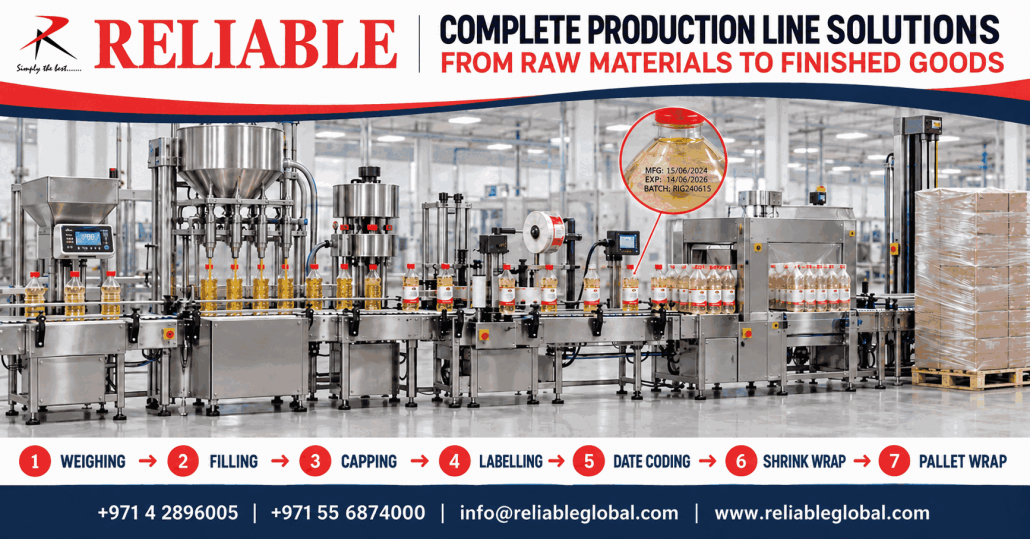
Reliable Industrial Group supplies complete production line solutions in the UAE for manufacturers that need accurate weighing, filling, capping, labelling, expiry date coding, shrink wrapping and pallet wrapping. Because every stage works as part of one connected process, customers can improve productivity, maintain consistent pack quality and simplify production control.

From a standalone machine to a fully integrated line, our team helps you select equipment that matches your product, container, production speed and available floor space. In addition, we support line planning, installation, commissioning, operator training and after-sales service across the UAE.

A Complete Packaging Process from Start to Finish

A successful production line must move products smoothly between each operation. Therefore, we review the complete process instead of treating every machine as an isolated purchase. The typical production sequence includes:

  1. Weighing for accurate product or ingredient measurement
  2. Filling containers with the required quantity
  3. Capping and closing bottles, jars or containers
  4. Labelling products with attractive and accurate labels
  5. Expiry date coding and marking for traceability
  6. Shrink wrapping individual products or multipacks
  7. Pallet wrapping finished loads for storage and transport

As a result, the finished line can take a product from initial measurement to a protected pallet ready for dispatch.

Seven Stages of Our Complete Production Line Solutions

1. Industrial Weighing Systems

Accurate weighing creates the foundation for consistent production. Depending on the application, manufacturers may need tabletop scales, platform scales, floor scales, tank weighing systems, load cells or automated dosing equipment. For example, a food producer may weigh ingredients before mixing, while a warehouse may verify the weight of finished cartons or pallets.

We help customers choose the correct capacity, readability, platform size and construction. Moreover, suitable indicators can connect to printers, computers, PLCs or production software for better records and traceability.

2. Filling Machines

After weighing or product preparation, the filling system dispenses the required amount into each container. We can support solutions for liquids, powders, granules, pastes and other products. Consequently, customers can improve fill consistency, reduce giveaway and increase production speed.

The correct filling method depends on the product viscosity, container opening, target volume, hygiene requirements and required output. Therefore, our team reviews product samples and production details before recommending a semi-automatic or fully automatic filler.

3. Capping and Container Closing

Capping equipment places and tightens closures after filling. Reliable closure control helps prevent leakage, contamination and product loss. In addition, it gives every pack a consistent and professional finish.

Available solutions may handle screw caps, press-on caps, pump closures and other common formats. The machine can also include cap feeding, cap detection and reject functions, depending on the line requirements.

4. Automatic Labelling Systems

Labelling systems apply product information and branding to bottles, jars, cartons, pouches and other packs. For instance, manufacturers may need wrap-around labels, front-and-back labels, top labels or tamper-evident labels.

Correct product handling is important because the label must remain straight, smooth and accurately positioned. Therefore, we match the conveyor, guides, sensors and applicator to the container shape and label material. Furthermore, the system can integrate with inspection and coding equipment.

5. Expiry Date Coding and Product Marking

Expiry date coding and marking adds essential production information to the product or packaging. Typical messages include manufacturing dates, expiry dates, batch numbers, lot numbers, serial numbers, barcodes, QR codes and Data Matrix codes.

Depending on the substrate and required mark, customers may use continuous inkjet printing, laser marking, thermal transfer printing or another coding method. As a result, clear codes can be applied to plastic, glass, metal, cartons, labels, films and pouches. Our team can test the product and recommend the most suitable technology for code quality, speed and durability.

6. Shrink Wrap Packaging

Shrink wrapping protects products and creates neat individual packs or multipacks. First, the machine surrounds the product with shrink film. Next, the sealed pack passes through a controlled heat tunnel. The film then tightens around the product to produce a secure and professional result.

Solutions can include L-sealers, continuous side sealers, sleeve wrappers and heat tunnels. Moreover, shrink wrapping can help protect packs from dust, improve presentation and keep grouped products together during handling.

7. Pallet Wrapping Systems

At the end of the line, pallet wrapping stabilises cartons or products for storage and transport. A stretch wrapper applies film around the pallet load while controlling tension and overlap. Therefore, the finished pallet remains more secure during forklift handling, warehousing and delivery.

Customers can choose manual, semi-automatic or automatic pallet wrapping solutions. In addition, available configurations may include turntable wrappers, rotary-arm systems, powered pre-stretch and automatic film cutting.

Integrated Packaging Automation

Complete production line solutions work best when the machines share a coordinated product flow. For this reason, line integration may include conveyors, accumulation tables, sensors, guarding, PLC controls, reject stations and production counters. The system can also exchange data with printers, inspection devices and factory software.

Good integration helps prevent product gaps, conveyor pressure and unnecessary stops. Moreover, it allows operators to monitor production from a clear control interface. As production needs change, a well-planned line can also support future upgrades.

Benefits of Complete Production Line Solutions from One Partner

  • Coordinated equipment: Each machine matches the speed and handling needs of the next stage.
  • Consistent product quality: Accurate filling, secure closing and correct labelling improve every finished pack.
  • Reliable traceability: Clear date, batch and machine-readable codes support product identification.
  • Improved efficiency: Automated transfer reduces manual handling and production delays.
  • Protected finished goods: Shrink and pallet wrapping prepare products for storage and transport.
  • One point of support: Customers receive coordinated assistance for the complete line.
  • Flexible expansion: Standalone machines can form part of a future automated system.

Complete Production Line Solutions for UAE Industries

Our equipment supports food and beverage, cosmetics, chemicals, pharmaceuticals, household products, lubricants, building materials, logistics and general manufacturing. However, every industry has different hygiene, speed, safety and traceability needs. We therefore recommend equipment only after reviewing the actual product and packaging process.

Reliable Industrial Group serves customers in Dubai, Abu Dhabi, Sharjah and throughout the UAE. Whether you need one machine or a complete production line, our specialists can help create a practical solution for your facility.

How to Plan Complete Production Line Solutions

Before requesting a quotation, prepare details about the product, container sizes, closure types, label dimensions, required codes and production speed. Also confirm the available utilities, factory layout, conveyor height and preferred level of automation.

Product samples are especially useful for filling, capping, labelling and coding trials. Meanwhile, layout drawings or photographs help our engineers review access, product flow and installation space. This information allows us to recommend complete production line solutions that suit both current production and future growth.

Support for Complete Production Line Solutions

Correct installation helps every machine operate safely and consistently. Our team can support equipment positioning, conveyor alignment, machine setup, product trials and operator training. In addition, we can help with coding-message setup, label adjustments and packaging-format changeovers.

After commissioning, planned maintenance and timely technical support help protect production uptime. Consequently, customers can operate their equipment with greater confidence.

Frequently Asked Questions

Can you supply a complete production line or only individual machines?

We can support both. Customers may begin with one machine or request an integrated line covering weighing, filling, capping, labelling, coding, shrink wrapping and pallet wrapping.

Can the line handle different bottle or container sizes?

Many systems support multiple formats through adjustable guides, change parts and saved settings. However, the exact range depends on the selected equipment and the difference between product sizes.

Which technology should we use for expiry date coding?

The correct choice depends on the packaging material, code content, line speed and required permanence. Therefore, we review samples before recommending inkjet, laser, thermal transfer or another marking method.

Can existing machines connect to a new production line?

In many cases, yes. First, our team reviews the existing machine speed, conveyor height, controls and safety requirements. We can then propose the most practical integration method.

Do you provide service in the UAE?

Yes. Reliable Industrial Group provides local support for equipment selection, installation, commissioning, training and after-sales requirements across the UAE.

Request a Complete Production Line Quotation

Looking for complete production line solutions in the UAE? Contact Reliable Industrial Group to discuss your product, packaging format, production speed and automation requirements. Our team will help you plan a connected process from accurate weighing to secure pallet wrapping.

Telephone: +971 4 2896005
Mobile/WhatsApp: +971 55 6874000
Email: [email protected]
Website: www.reliableglobal.com
Contact: Speak with our UAE packaging specialists
Laser Marking Machine for Products in the UAE

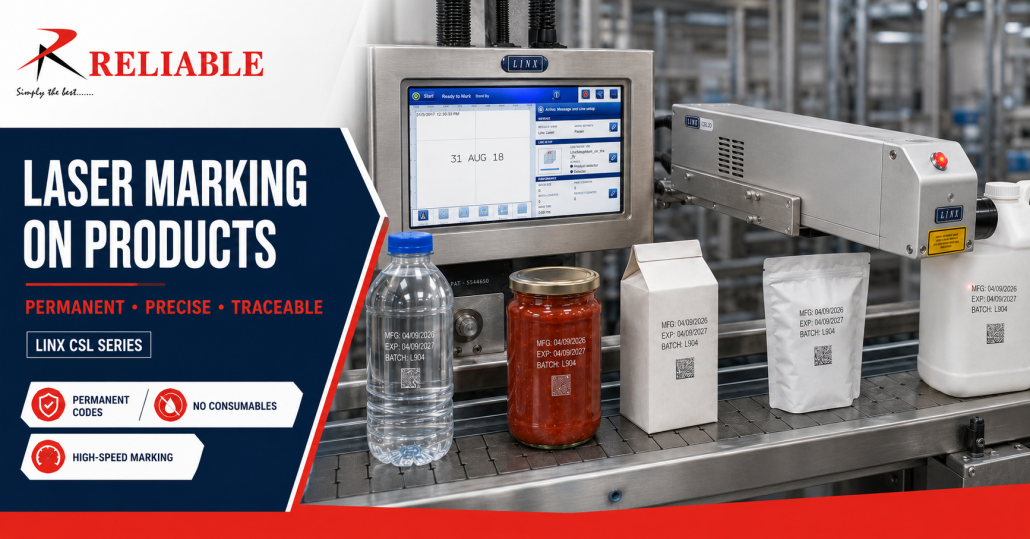
Linx CSL laser marking machine applying permanent codes to products in UAE

Permanent, precise and consumable-free coding for modern production lines.

Reliable Industrial Group supplies laser marking machines for products across the UAE. Our solutions create clear and permanent codes on bottles, cartons, labels, films, pouches, glass and plastic packaging. Therefore, manufacturers can apply expiry dates, manufacturing dates, batch numbers, serial numbers, barcodes, Data Matrix codes, QR codes, graphics and logos without ink or ribbon.

The Linx CSL Series uses industrial CO₂ laser technology for fast, accurate and reliable coding. The laser changes the product or packaging surface to create a permanent mark. Depending on the material, it can engrave, etch, remove a coated layer or change the surface colour. As a result, the code becomes an integral part of the product rather than a separate ink deposit.

Permanent Laser Marking for Products and Packaging

Product codes support identification, traceability, stock rotation and quality control. However, the correct coding method depends on the substrate, production speed, code size, contrast and installation area. Our team reviews these details before recommending a laser configuration.

A well-selected laser marking system produces consistent codes while reducing routine consumable handling. In addition, permanent marks resist smudging and accidental removal. This makes laser coding useful for high-speed operations that need dependable results throughout the product lifecycle.

Linx CSL Series CO₂ Laser Coders

The Linx CSL Series includes the CSL10, CSL30 and CSL60 industrial CO₂ laser coders. Each model supports different production requirements. For example, the CSL10 offers an economical 10-watt option for versatile applications. The CSL30 provides 30 watts for sharper codes on faster lines and difficult materials. Meanwhile, the 60-watt CSL60 suits demanding, high-throughput environments and can include IP65 protection.

The range offers flexible marking-head, lens and beam-delivery configurations. Consequently, engineers can integrate the laser in different orientations and line layouts. Adjustable-focus technology also helps operations that run products with different heights or widths, because the system can change the working distance without requiring the complete laser assembly to move.

A built-in pilot laser helps position the mark, while the focus finder supports accurate setup. Furthermore, flat-field correction helps maintain code quality across the marking area. Operators can create and manage messages through the LinxVision colour touchscreen and software.

What Can a Laser Marking Machine Print?

The Linx CSL Series can mark both fixed and variable information. Common code formats include:

  • Manufacturing and production dates
  • Expiry and best-before dates
  • Batch, lot and shift codes
  • Serial numbers and variable text
  • One-dimensional barcodes
  • Data Matrix and QR codes
  • GS1-compatible 2D codes
  • Logos, symbols and simple graphics

Because the laser uses software-controlled mirrors, it can form precise text and graphics at production speed. It can also flip, mirror or curve a message to suit different product shapes.

Materials Suitable for CO₂ Laser Marking

PET and Plastic Containers

Manufacturers use laser marking on selected PET, HDPE and other plastic packaging. The mark may appear as a colour change, surface engraving or removal of a printed coating. However, every plastic responds differently. Therefore, a sample test helps confirm the best wavelength, power, speed and contrast.

Glass Bottles and Jars

CO₂ laser systems can create frosted or opaque marks on glass containers. This suits beverage bottles, food jars and other glass packaging. The Linx VisiCode feature supports visible coding on cold glass by controlling the laser pulse pattern. As a result, the code remains clear without using labels or ink.

Cartons, Paper and Labels

Laser coders can remove a printed layer or change the surface of cartons, paperboard and suitable labels. This method can produce high-contrast dates, batch codes and machine-readable symbols. In addition, the non-contact process avoids mechanical pressure on lightweight packaging.

Flexible Films and Pouches

Many coated films and flexible packs can accept laser codes. Nevertheless, the material structure, coating and barrier layer must suit the laser. A practical test confirms that the code is clear without weakening the pack or damaging its seal performance.

Rubber and Industrial Components

The Linx CSL Series can also mark selected rubber and industrial materials. These applications may include identification, traceability, part numbers, production details and logos.

Benefits of Laser Coding

  • Permanent marks: Codes become part of the product surface and resist smudging.
  • No ink or ribbon: CO₂ laser marking does not require routine coding consumables.
  • High-speed operation: The system can process complex data on fast production lines.
  • Sharp code quality: Precise control supports small text, graphics and 2D codes.
  • Low intervention: Long laser-tube life and extended service intervals reduce disruption.
  • Flexible integration: Multiple heads, lenses and beam paths suit varied layouts.
  • Secure operation: Password controls help authorised users manage message changes.
  • Clean production: The process creates minimal waste compared with consumable-based coding.

Applications Across UAE Industry

Our laser marking solutions support food and beverage plants, pharmaceutical facilities, cosmetics production, electronics, automotive parts, extrusion operations and general manufacturing. Companies in Dubai, Abu Dhabi, Sharjah and across the UAE use laser coders for primary packaging, secondary packaging and direct-part marking.

For food and beverage packaging, a laser can add production dates, expiry dates and lot codes to bottles, jars, cartons and selected films. Pharmaceutical and cosmetic manufacturers can use precise text and 2D codes for identification and traceability. Industrial producers can also mark components with serial numbers, logos and manufacturing information.

High-Speed Coding and Production-Line Integration

The CSL Series can support high-speed applications with complex variable data. Its processor handles detailed messages and 2D barcodes while maintaining code quality. Moreover, the range provides detector, encoder, beacon, fume-extraction, safety-interlock, serial and Ethernet connections.

Correct integration remains essential. First, engineers establish the marking distance and product position. Next, sensors trigger the laser as each product enters the marking field. Finally, guarding, interlocks and fume extraction protect the process and production area. Reliable Industrial Group can coordinate the laser, mounting structure, enclosure, sensor, encoder and extraction system as one practical solution.

How to Select the Right Laser Marking System

Before requesting a quotation, prepare the following information:

  1. Product and material: Identify the substrate, colour, coating and surface finish.
  2. Code content: Confirm text, dates, batch data, barcode or 2D-code requirements.
  3. Production speed: Provide the line speed and products per minute.
  4. Code area: State the available marking location and maximum message size.
  5. Product variation: List changes in height, width, shape or material.
  6. Environment: Explain washdown, dust, temperature and humidity conditions.
  7. Integration: Describe sensors, encoders, PLC, database and network needs.
  8. Safety and extraction: Share the available space for guarding and fume removal.

Sample testing is an important step. It confirms achievable contrast, code quality and production speed on the actual material. Therefore, send representative samples whenever possible.

Installation, Training and Support in the UAE

Reliable Industrial Group helps customers choose, install and support industrial coding equipment. Our team can review your production line, test product samples, recommend a Linx CSL model and plan the correct mounting and guarding. In addition, we support operator training, message setup, preventive maintenance and technical service.

We focus on the complete application rather than only the laser source. Consequently, your proposal can include the controller, marking head, lens, mounting frame, protective enclosure, sensor, encoder, fume extractor and production-line communication.

Frequently Asked Questions

Is laser marking permanent?

Yes. The laser changes or removes part of the surface to form the code. Therefore, the result does not wipe away like an ink deposit.

Does a CO₂ laser require ink or ribbon?

No. A CO₂ laser creates the mark using focused light, so it does not need ink or thermal-transfer ribbon.

Can the Linx CSL Series mark expiry dates and batch codes?

Yes. It can mark dates, times, variable text, serial numbers, shift codes, barcodes, Data Matrix codes, QR codes, graphics and logos.

Can one laser mark different product sizes?

Yes, subject to the chosen configuration and marking field. Adjustable-focus technology can simplify changeovers between products of different heights or widths.

Can laser coders mark glass and PET?

Yes. The CSL range supports glass, PET and other selected packaging materials. However, the best settings and wavelength depend on the exact substrate, so sample testing is recommended.

Which CSL model should I choose?

The correct model depends on material, code complexity, line speed and operating environment. The CSL10, CSL30 and CSL60 provide different power levels for varied production demands.

Request a Laser Marking Machine Quotation

Looking for a laser marking machine for products in the UAE? Contact Reliable Industrial Group to test your samples and select the correct Linx CSL laser, marking head, lens, enclosure and line-integration package.

Telephone: +971 4 2896005
Mobile/WhatsApp: +971 55 6874000
Email: [email protected]
Website: www.reliableglobal.com
Contact: Speak with our UAE coding specialists
Product reference: Linx CSL Series laser coders

Expiry Date Printing on Food Products and Packaging in the UAE

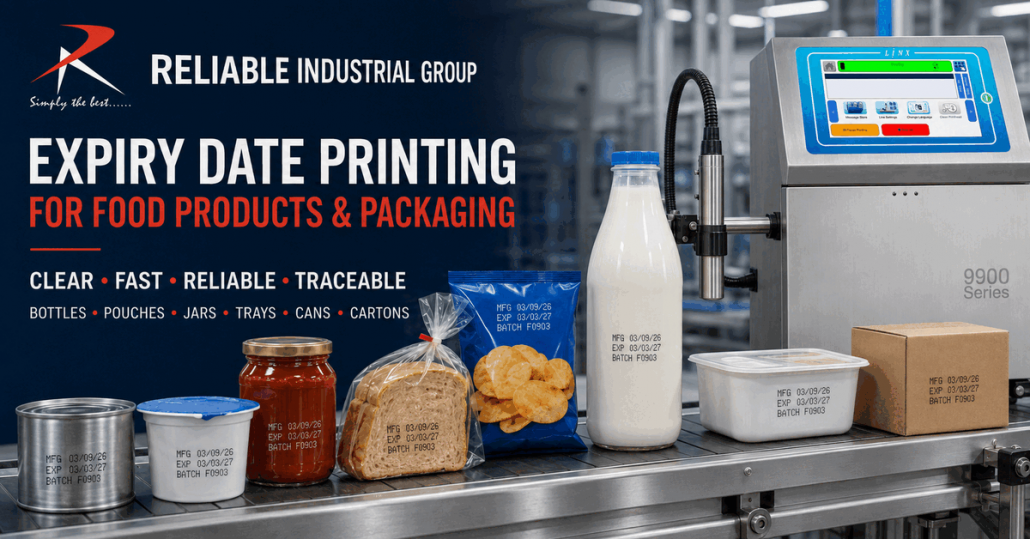
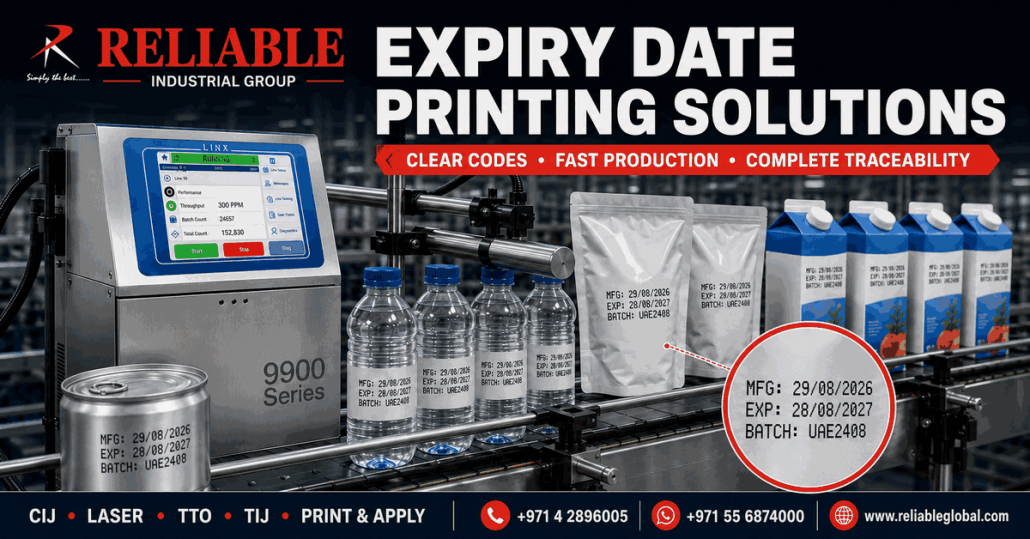
Linx 9900 expiry date printer for food products and packaging in UAE

Clear, accurate and reliable MFG, EXP, batch and traceability codes for modern food-production lines.

Reliable Industrial Group supplies expiry date printing on food packaging solutions for manufacturers across Dubai, Abu Dhabi, Sharjah and the wider UAE. Our industrial coding systems print manufacturing dates, expiry dates, best-before dates, batch numbers, lot numbers, barcodes and other essential information directly onto food products and packaging.

Food manufacturers work with many substrates, production speeds and operating conditions. Therefore, the correct printer must match the package material, code size, line speed, installation space and cleaning environment. Our team helps customers choose a practical solution for bottles, pouches, films, bread bags, jars, trays, cans, labels and corrugated cartons.

Reliable Food Packaging Date Coding

Accurate product coding supports traceability, stock rotation and quality control. In addition, a clear code helps retailers and consumers identify important product information quickly. Automated coding also reduces manual marking and allows operators to focus on production.

A suitable coding system can print fixed and variable information, including:

  • Manufacturing date
  • Expiry date or best-before date
  • Batch and lot number
  • Production time and shift code
  • Product or line identification
  • Linear and two-dimensional barcodes
  • Promotional or traceability information

Food Products and Packaging Applications

Bottles and Jars

Continuous inkjet printers can apply non-contact codes to plastic and glass bottles, jars, caps and closures. Because the printhead does not touch the product, the system suits moving production lines and curved surfaces. Typical applications include milk bottles, juice bottles, sauces, cooking oils, condiments and preserved foods.

Pouches, Films and Bread Bags

Flexible packaging requires a code that remains readable on the selected film. For example, snack pouches, frozen-food bags, bakery films, flow wraps and laminated packs may need continuous inkjet or thermal transfer printing. The best option depends on the packaging film, print location, line movement and required code quality.

Trays, Cups and Cans

Food trays, yoghurt cups, dairy containers and metal cans may carry codes on the lid, base, side or label. Therefore, we review product handling and available print distance before recommending the printer and mounting arrangement. Stable product guidance helps maintain consistent code position.

Labels and Corrugated Cartons

Manufacturers often need coding on both primary and secondary packaging. A product may receive a date and batch code, while its outer carton carries larger text, handling information or a barcode. Large-character printers can apply clear information directly onto corrugated cartons, which may reduce the need for pre-printed carton variations.

Printing Technologies for Food Packaging

Continuous Inkjet Printers

Continuous inkjet, commonly called CIJ, provides fast non-contact coding on a wide range of materials and shapes. It suits bottles, jars, pouches, cans, cartons and many other moving products. Moreover, compact printheads make CIJ useful where installation space is limited.

Different inks are available for specific substrates and operating conditions. Consequently, ink selection should consider adhesion, drying time, package colour, moisture, temperature and food-production requirements.

Linx 9900 Series Expiry Date Printer

The Linx 9900 Series provides reliable continuous inkjet printing for food products and packaging. Its non-contact printhead can apply clear manufacturing dates, expiry dates, batch numbers, lot codes, text and machine-readable codes while products move along the production line.

The Linx 9900 Series can print up to six lines and supports text, numbers, symbols, barcodes, QR codes, Data Matrix and GS1 Data Matrix. In addition, the 10-inch colour touchscreen helps operators create, select and check production messages. The printer stores up to 1,000 messages, which makes regular product changeovers easier to manage.

For demanding food-production areas, an optional IP65 configuration provides additional ingress protection. Moreover, the printer supports different nozzle sizes, a broad selection of inks, Ethernet and USB connections, and integration with Linx PrinterNet and the optional Linx Iris vision system.

Reliable Industrial Group can review the package material, code format, production speed and installation environment before recommending the appropriate Linx 9900 configuration, ink and printhead mounting arrangement.

Thermal Transfer Overprinters

Thermal transfer overprinting, or TTO, produces high-resolution text, dates, barcodes and graphics on flexible packaging films and labels. It works particularly well on intermittent and continuous packaging machines used for snacks, bakery products, frozen foods and other bagged products.

Laser Coding Systems

Laser coders create permanent, non-contact marks without printer ink. Depending on the material, they can code labels, cartons, films and selected plastic or glass packaging. However, every substrate reacts differently, so a sample-marking test is essential before final selection.

Large-Character Carton Printers

Large-character printers produce bold, readable codes on secondary packaging such as corrugated boxes, trays and cases. They can print product descriptions, dates, batch details, barcodes and handling information directly on the carton.

Benefits of Automated Expiry Date Printing

  • Clear codes: Consistent printing improves readability on the selected package.
  • Fast operation: Automated printing supports continuous production without manual labelling.
  • Fewer operator errors: Stored messages and controlled selection reduce incorrect code entry.
  • Product traceability: Batch and lot information supports production and quality records.
  • Flexible applications: Solutions are available for primary and secondary food packaging.
  • Line integration: Printers can connect with sensors, encoders and production controls.
  • Reduced downtime: Correct selection and maintenance help keep the line available.
  • Professional presentation: Neat codes support a consistent finished package.

Code Verification and Production Control

Printing the code is only one part of a reliable process. First, the production team must select the correct message. Next, the printer must place a readable code in the approved location. Finally, an operator or vision system should confirm that the code is present and correct.

Depending on the application, the coding system can receive signals from a product sensor or line encoder. It may also communicate with production software or a vision-inspection system. As a result, manufacturers can improve control and reduce the risk of missing, unreadable or incorrect codes.

Choosing the Right Food Coding Printer

Please confirm the following details before requesting a quotation:

  1. Food product: Explain what you manufacture and how it moves on the line.
  2. Packaging material: Specify plastic, film, glass, metal, paper, label or carton.
  3. Required message: Provide the number of lines, characters, barcode type and code size.
  4. Production speed: Confirm products per minute and conveyor speed.
  5. Print location: Identify the required code position and available mounting space.
  6. Environment: Note moisture, washdown, dust, temperature and cleaning conditions.
  7. Integration: Mention sensors, encoders, packaging machines, software or vision requirements.
  8. Code sample: Share product photographs and an example of the required print.

These details allow our team to recommend the correct technology, ink, printhead arrangement and accessories. In other words, we select the solution around the actual product and production line rather than relying on a general printer specification.

Installation and Support Across the UAE

Reliable Industrial Group supports food manufacturers with printer selection, installation, commissioning, operator guidance and after-sales assistance. We can also review an existing production line that needs clearer codes, improved reliability or a more suitable printer position.

During installation, correct mounting is essential. The printhead should remain stable, the product should pass at a controlled distance, and the sensor should detect every package reliably. In addition, the printer must remain accessible for normal operation and maintenance.

Why Choose Reliable Industrial Group?

We combine industrial coding experience with local UAE support. Therefore, customers receive more than a standalone printer. Our team reviews the product, packaging, line speed, code requirement and production environment to develop a complete coding solution.

Whether you need expiry date printing on a milk bottle, snack pouch, bread bag, jar, tray, can or outer carton, we can help you identify a reliable system for your food-production process.

Explore our industrial solutions or contact our UAE coding specialists to discuss your application.

Frequently Asked Questions

Which printer is best for expiry dates on food packaging?

The best printer depends on the substrate, line speed, code size and production environment. CIJ suits many bottles, jars, cans and packs, while TTO suits flexible films. Laser coding and large-character printing serve other specific applications.

Can one printer mark different food packages?

Yes, many printers can store different messages and code several compatible products. However, each material should receive an adhesion and readability test before production.

Can the system print MFG, EXP and batch details automatically?

Yes. Industrial coding systems can calculate dates and print variable batch information. Controlled message selection can also reduce manual entry and changeover errors.

Can you print on plastic, glass, metal and cartons?

Yes. Different technologies and inks support these materials. The correct combination depends on surface characteristics, production speed and required durability.

Are food-safe and low-odour inks available?

Specialist inks are available for selected food-packaging applications, including low-odour and substrate-specific options. The final ink must match the packaging, regulatory needs and printer model.

Can the printer connect to a packaging machine or vision system?

Many industrial printers can work with product sensors, encoders, production controls and vision systems. Confirm the interface and workflow during project review.

How many lines can the Linx 9900 Series print?

The Linx 9900 Series can print up to six lines, depending on the selected model, message format and application. It can also produce barcodes and two-dimensional codes for advanced traceability requirements.

What details do you need for a quotation?

Please send product and packaging photographs, substrate type, required code, products per minute, conveyor speed, print location and site conditions. A short production-line video is also helpful.

Request a Food Packaging Coding Quotation

Contact Reliable Industrial Group for an expiry date printer suitable for your food product, package material and production speed.

Telephone: +971 4 2896005
Mobile/WhatsApp: +971 55 6874000
Email: [email protected]
Website: www.reliableglobal.com

Expiry Date Printer Solutions in the UAE

expiry date printer

Reliable Industrial Group supplies expiry date printer solutions in the UAE for clear dates and batch codes on products and packaging. Our systems help factories link each pack to its production batch. In addition, we help you choose a printer that suits your product, line speed and working conditions.

Different surfaces need different coding methods. For example, a plastic bottle may need an inkjet code, while a film wrapper may suit ribbon printing. Therefore, we review your pack material and test the print where needed before we recommend a system.

Send your product photos and code details for printer selection

What Is an Expiry Date Printer?

An expiry date printer adds dates, batch numbers and other changing data during production or packing. It works beside equipment such as conveyors, filling machines and wrappers. As a result, staff can code packs as part of the normal line process.

A sensor detects each product and triggers the printer. Next, the printhead applies the saved message in the chosen spot. Depending on the system, ink, ribbon or a laser creates the code. A print-and-apply system can also place the data on a label.

How Automatic Date Coding Works

  1. Set the message: First, the operator enters the date, batch number and other required data.
  2. Detect the pack: Next, a sensor or machine signal controls when printing starts.
  3. Apply the code: The printer places the message on the pack in step with the line.
  4. Check the result: Then, staff or an optional camera checks the code and its position.
  5. Review production: Finally, staff can review print counts and alarms where the system supports these features.

The product must stay stable during printing. Therefore, correct guides, mounts and printhead spacing help maintain clear codes.

Expiry Date Printer Technologies

Continuous Inkjet Date Printers

Continuous inkjet, or CIJ, prints without touching the product. It suits many bottles, cans, jars and other packs on moving lines. In addition, a choice of inks helps match the code to the surface, colour and drying needs.

For example, a chilled bottle may need different ink from a dry carton. We therefore review moisture, handling and storage conditions when choosing the ink.

Laser Date Coding Systems

A laser coder changes the product surface to create a mark without ink or ribbon. Depending on the material and laser type, it can change the colour, remove a thin coating or mark the surface. However, each pack needs a suitable laser setup and sample testing.

Explore our permanent laser marking example to see a packaging use. Laser systems also need suitable guarding and fume extraction for the task.

Thermal Transfer Overprinters

Thermal transfer overprinting, or TTO, uses a heated printhead and ribbon to print on flexible film. For example, it can code snack bags, bakery packs and pouches. It can also print text, logos and barcodes where the selected model supports them.

Thermal Inkjet Printers

Thermal inkjet, or TIJ, uses a compact cartridge system to print fine text and codes. It suits cartons, paper, labels and selected other surfaces with the correct ink. Therefore, we check ink adhesion and print distance before choosing a model.

Large Character and Label Printing

Large character printers add text and product codes to outer cases and other secondary packs. As a result, factories can change batch details without changing their stock of plain boxes.

Alternatively, print-and-apply systems print data on a label and place it on a pack, case or pallet. This approach suits jobs that need a label instead of a direct surface code.

What Can an Expiry Date Printer Print?

The selected printer can support several message types. For instance, a pack may need both an expiry date and a batch number. Available functions vary by model, so we confirm your full message before selection.

  • Manufacturing, expiry and best-before dates
  • Batch, lot and shift numbers
  • Serial numbers and product codes
  • Time and production-line details
  • Barcodes, QR codes and Data Matrix codes
  • Logos and other required text

However, a printer’s ability to produce a barcode does not alone confirm that it meets your scanning needs. Code size, print quality, data format and reader tests also matter.

Products and Packaging for Date Coding

Our expiry date printer solutions cover a wide range of packs. These include plastic bottles, glass jars, metal cans, cartons, pouches and trays. In addition, suitable systems can mark caps, labels, pipes, wires and outer cases.

Each surface affects code contrast and durability. For example, dark packs may need a light ink, while rough surfaces may need a different print setup. Sample tests help confirm the result before installation.

Industries Using Expiry Date Printers

Food plants, dairies, bakeries and drink producers use date codes to identify batches and shelf-life information. Likewise, medicine, cosmetics and chemical firms need clear product data. Industrial plants also use coding to track parts and production runs.

However, the same setup will not suit every site. Wet areas, dust and frequent cleaning can change the equipment needs. Therefore, our team checks the line conditions as well as the printed message.

Benefits of Automatic Expiry Date Printing

  • Clear codes: Match the print method to the pack and line speed.
  • Less manual work: Code products during the normal packing process.
  • Better message control: Use saved messages and access settings to help reduce entry errors.
  • Batch tracking: Link packs to production records.
  • Faster changeovers: Update dates and batch data without replacing packaging stock.

In addition, regular code checks help staff spot a missed or unclear print early. This gives the team a chance to correct the cause and inspect affected packs.

How to Select the Right Expiry Date Printer

First, send us a photo of the product and the pack material. Next, share the exact message, code size and number of lines. We also need the production speed and the space available for the printhead.

  • Pack material, surface colour and print location
  • Products per minute and conveyor speed
  • Belt direction, height and mounting space
  • Heat, dust, moisture and cleaning conditions
  • Ink colour, contrast and code durability needs
  • Barcode, database and camera requirements
  • Links to a PLC or production software

Finally, tell us how staff handle and store the packs after coding. These details help us choose a solution that suits the complete process.

Line Setup and Code Checks

Our team fits mounts to keep the printhead at the right distance and angle. Where needed, an encoder helps the printer follow changes in belt speed. As a result, the code can stay consistent as the line runs.

In addition, an optional camera can check code presence and position. More advanced checks may read text or grade barcodes, depending on the camera and software. We confirm the required checks during the project review.

Expiry Date Printer Support in the UAE

Reliable Industrial Group helps with printer selection, sample tests, installation, start-up and staff training. We can also review consumables and ongoing support needs. Explore our coding and marking solutions for related equipment.

We serve customers across the UAE, including Dubai, Abu Dhabi, Sharjah and Ajman. To discuss your line, contact our UAE team. You can also view our wider industrial weighing and packaging solutions.

Frequently Asked Questions

Which expiry date printer suits my product?

The right choice depends on your pack, message and line speed. For example, CIJ suits many moving products, while TTO suits flexible film. Sample tests help confirm the final choice.

Can a date printer code moving products?

Yes, suitable industrial coders print as products move along a conveyor. However, the printer must match the speed and required print quality.

Can one printer print dates and QR codes?

Many models support both. Before selection, we check the code size, data and speed to confirm that the chosen printer can handle the full message.

Can the printer connect to our production software?

Many systems support data links. However, we need to confirm the protocol, message source and control needs for your chosen model.

What do you need for a quotation?

Please send product photos, pack material, sample text and line speed. In addition, share the print location and any camera or software needs.

Request an Expiry Date Printer Proposal

Looking for an expiry date printer in the UAE? Send your product details to Reliable Industrial Group. Our team will review your needs and suggest a date coding system for your line.

Reliable Industrial Group
Telephone: +971 4 2896005
Mobile/WhatsApp: +971 55 6874000
Email: [email protected]
Website: www.reliableglobal.com

Automatic Checkweigher UAE | Inline Weight Inspection

Automatic Checkweigher UAE | Inline Weight Inspection

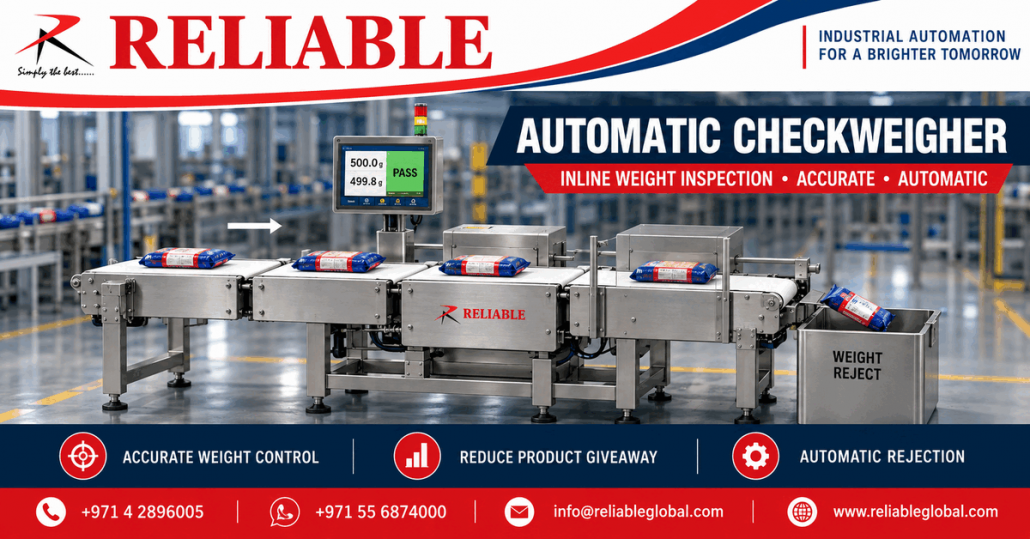
Reliable Industrial Group supplies automatic checkweigher systems in the UAE to check product weight on production and packing lines. Each system weighs packs as they move and compares the result with set limits. It then removes packs that fall outside the accepted range.

This helps food, drink, bakery, medicine, cosmetics and industrial firms control pack weight. In addition, weight data can reveal excess filling and reduce product giveaway. We review your product, pack size, target weight and speed before choosing the machine.

Send your product details for checkweigher selection

What Is an Automatic Checkweigher?

An automatic checkweigher checks the weight of each product during production. A static scale usually needs the pack to stop. In contrast, a dynamic system measures the pack while it crosses a separate weighing belt.

The controller compares the weight with saved limits. Packs within the range continue along the line, while a reject unit removes those outside it. As a result, staff can focus on the cause of failed checks and review the affected products.

Depending on the model, the screen can show pack counts, rejects and average weights. In addition, stored results can help teams track changes during a batch or shift.

How an Automatic Checkweigher Works

  1. Product infeed: First, the infeed section spaces the packs for weighing.
  2. Weight capture: Next, each pack crosses the weighing belt, where a load cell measures its weight.
  3. Weight decision: The controller checks the result against the lower and upper limits.
  4. Rejection: Then, a separate unit after the weighing belt removes a failed pack.
  5. Reporting: Finally, the system records results where the selected software supports this function.

Stable packs and correct spacing help the machine weigh well. Therefore, we check product transfer points and belt lengths during selection.

Automatic Checkweigher Options for Your Line

Standard Automatic Checkweighers

Standard models check cartons, bottles, jars, cans, trays and pouches. For example, they can inspect filled packs before case packing. The right model depends on the pack weight, size and required speed.

High-Speed Automatic Checkweighers

Fast lines need smooth product handling and precise reject timing. Therefore, we review pack spacing, belt stability and the available weighing time. This helps us match the system to the line without creating a bottleneck.

Multi-Lane Automatic Checkweighers

Some lines move products through parallel lanes. In these cases, a multi-lane system can check selected bakery, snack or portion packs. However, the lane count and product layout must suit the upstream machine.

Combined Weight and Metal Inspection

A combined system checks weight and searches for metal contaminants within one line section. As a result, it can save space where both checks are necessary. Separate reject stations and bins can also keep metal rejects apart from packs that fail the weight check.

Automatic Checkweigher Reject Systems

The reject method must suit the pack and speed. Options include air jets, pushers, diverters and drop flaps. For instance, a light pouch may need a different method from a heavy box.

Where automatic removal is unsuitable, a stop-and-alarm setup can let staff remove the pack. However, this option pauses the line. We also review reject confirmation and the collection bin so rejected goods stay separate from accepted packs.

Benefits of an Automatic Checkweigher

  • Check each pack: Inspect weight throughout normal production.
  • Identify low weights: Remove packs below the set limit.
  • Reduce excess filling: Use weight trends to improve fill settings.
  • Keep checks consistent: Apply the same limits across a batch.
  • Save handling time: Use automatic rejection where the application allows.
  • Review results: Track counts, rejects and weight trends on supported systems.

For example, a rising average weight may point to excess filling. The production team can then review the filler and adjust it. Thus, the machine provides useful data as well as a pass-or-fail result.

Products for Inline Weight Inspection

Our automatic checkweigher solutions cover a wide range of packaged products. Typical examples include:

  • Bread, bakery packs and snacks
  • Meat, seafood and frozen-food packs
  • Dairy products and ready meals
  • Bottles, jars and cans
  • Medicine cartons and healthcare packs
  • Cosmetics and personal-care products
  • Pouches, sachets and trays
  • Boxed parts and industrial goods

However, soft, tall or unstable packs may need extra guides or a different transfer method. Product samples help us check these needs before final selection.

Automatic Checkweigher Controls and Data

Available features vary by model. They may include a touchscreen, saved product settings, speed control, weight reports and data export. In addition, selected systems can exchange signals or data with other line equipment.

Optional controls may include reject confirmation, bin-full sensors, guards and remote monitoring. Therefore, please tell us which functions your team needs. See our inline weight inspection equipment for related product information.

Adding a Checkweigher to an Existing Line

An automatic checkweigher can follow filling, sealing, wrapping or cartoning. First, we review the belt height, travel direction and free space. Next, we check the product transfers, power supply and control signals.

Our scope can cover equipment selection, installation, calibration, start-up and staff training. In addition, we can plan the reject bin and handling method. This helps staff keep failed packs apart from accepted production.

How to Select Your Automatic Checkweigher

Please send the following details so we can review your line:

  • Product photos and pack material
  • Smallest and largest pack dimensions
  • Minimum, maximum and target weights
  • Packs per minute and conveyor speed
  • Conveyor height, direction and free space
  • Allowed weight limits and required accuracy
  • Preferred reject method and bin layout
  • Cleaning, washdown and site conditions
  • Metal detection or software needs

Accuracy depends on the product, speed and site conditions. For example, vibration or unstable packs can affect the result. Therefore, we confirm the expected performance for your chosen setup.

Reliable Industrial Group Support in the UAE

Reliable Industrial Group combines weighing equipment knowledge with production-line support. We review the complete process, from product infeed to reject handling. As a result, the proposed solution considers both the weight check and how staff run the line.

We support customers across Dubai, Abu Dhabi, Sharjah, Ajman and the other UAE emirates. You can also explore our industrial weighing equipment or contact our UAE team to discuss your project.

Automatic Checkweigher FAQs

Can the machine reject both low and high weights?

Yes. Staff set lower and upper limits, and the reject unit removes packs outside that range. However, the reject method must suit the pack and line speed.

Can an automatic checkweigher reduce giveaway?

It provides weight data that can reveal excess filling. Your team can then use this data to adjust the filling or portioning process.

Can I add one to an existing line?

Yes, where the line layout and product handling allow it. First, we check the space, belt height, speed and required signals.

Can it work with metal detection?

Yes, suitable combined systems support both checks. In addition, separate reject bins can keep each type of failed pack apart.

What details do you need for a quotation?

Please send product photos, pack sizes, weights and production speed. Also include the weighing limits, available space and reject requirements.

Request an Automatic Checkweigher Proposal

Looking for an automatic checkweigher in the UAE? Send your product details to Reliable Industrial Group. Our team will review the line and recommend a suitable weighing and reject setup.

Reliable Industrial Group
Telephone: +971 4 2896005
Mobile/WhatsApp: +971 55 6874000
Email: [email protected]
Website: www.reliableglobal.com

Laser Marking on Tobacco Boxes

Laser Marking on Tobacco Boxes in UAE | Reliable

Laser Marking on Tobacco Boxes in UAE | Reliable

Laser Marking on Tobacco Boxes

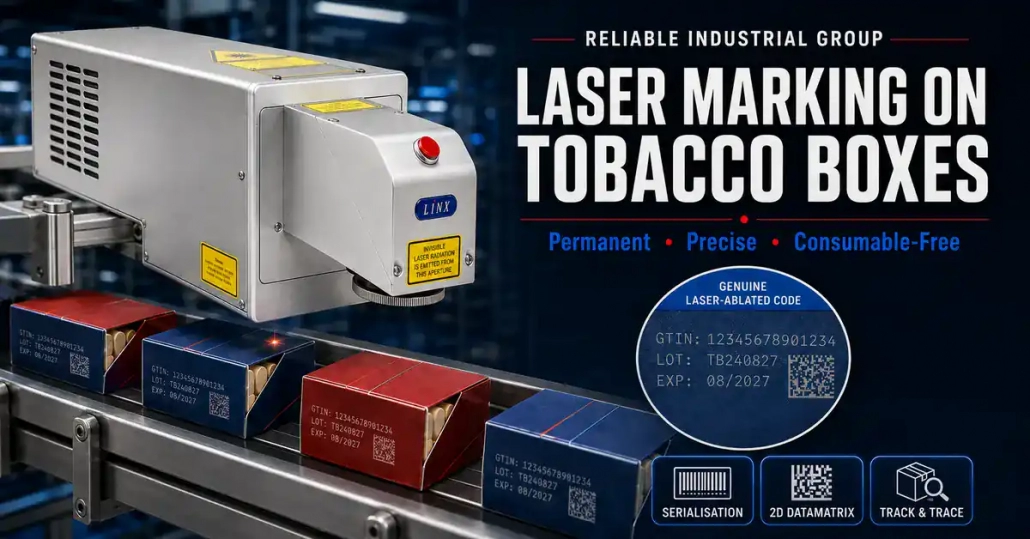
Reliable Industrial Group provides laser marking on tobacco boxes for dates, batch numbers and unique pack codes in the UAE. These systems mark the carton surface during the packing process. In addition, they can link each pack to production data through suitable software and code-reading equipment.

A laser changes the surface instead of adding ink. As a result, it can create a lasting code on a suitable coating. However, the final contrast and durability depend on the carton, laser type and marking settings.

How Does Laser Marking on Tobacco Boxes Work?

The laser uses a focused beam to change or remove a thin layer of the carton coating. For example, it may reveal a lighter layer beneath a dark printed surface. This creates contrast between the code and its background.

First, our team tests your packaging sample. Next, we check the mark, code size and available production time. These tests help us select the laser and settings without harming the pack.

Depending on the system and material, the laser can mark:

  • Manufacturing and expiry dates where required
  • Batch and lot numbers
  • Unique serial numbers
  • Data Matrix codes, including suitable GS1 formats
  • Barcodes and product details
  • Logos and symbols

Laser Marking on Tobacco Boxes for Serialisation

Serialisation gives each pack its own identity. A database can link this unique code to batch, production and distribution records. Therefore, a business can use the code to look up a pack’s history within its tracking system.

A connected laser can receive changing data from line software and mark each pack. In addition, a camera can read the result and check it against the expected code. The line can then divert packs with missing, wrong or unreadable codes for review.

However, printing a unique number alone does not provide complete traceability or prove that a pack is genuine. The project also needs valid data, checks and records at the relevant stages. We review these needs with your team before choosing the setup.

Steps in the Tobacco-Box Laser Marking Process

  1. Detect the pack: First, a sensor detects each box as it enters the marking area.
  2. Track movement: Next, an encoder or line signal helps the laser follow the product speed.
  3. Position the mark: The marking head directs the beam onto the chosen area of the carton.
  4. Apply the code: Then, the laser marks the required text or machine-readable code.
  5. Check the result: An optional vision system checks code presence, position and readability.
  6. Record the outcome: Finally, connected software can save marking and inspection results.

Stable product handling helps maintain a clear mark. Therefore, we check the carton guides, spacing and available marking time as part of the line review.

Benefits of Laser Marking on Tobacco Boxes

Durable Tobacco Packaging Codes

Laser marking changes the packaging surface, so the code can resist normal handling. Unlike an ink layer, the mark does not rely on ink adhesion. However, abrasion or damage to the carton can still affect it, so sample tests should reflect real handling conditions.

No Printing Ink or Makeup Solvent

The laser does not use printing ink or makeup solvent. As a result, it avoids routine ink refills and solvent storage for coding. It still needs care, such as lens checks and extraction-filter changes where applicable.

Fine Text and Machine-Readable Codes

A suitable laser can mark small text and detailed 2D codes on a tested carton coating. In addition, good contrast helps cameras and readers capture the data. We confirm the code size and reading needs during sample trials.

Marking at Production Speed

Industrial laser coders can mark moving cartons when the setup suits the line. However, the speed depends on the code content, marking area and material. Therefore, we assess the full message at your target rate.

Support for Pack Tracking

Unique codes can connect each pack to its production record. For example, staff can use a scan to look up the batch or shift in a linked database. This supports tracking when the required data and software are in place.

Integrating Laser Marking on Tobacco Boxes

Reliable Industrial Group can fit laser coding equipment to suitable new or existing tobacco packing lines. First, we review the conveyor layout, carton material and code requirements. Next, we plan the mounting position, guards and extraction system.

A complete project may include:

  • Industrial laser coder and mounting stand
  • Product sensors and encoders
  • Laser guards and interlocks
  • Fume extraction equipment
  • PLC and production-software links
  • Serialisation data exchange
  • Code-reading and inspection cameras
  • Automatic rejection and reject confirmation
  • Production reports and database links

In addition, we review how staff change messages and handle rejected packs. This helps the equipment fit the daily workflow as well as the physical line.

Choosing a Tobacco Packaging Laser System

To assess laser marking on tobacco boxes, please send sample cartons and photos of the line. We also need the coating details, smallest code size, full message and packs per minute.

Next, share the conveyor height, travel direction and free space around the marking point. If the project includes serialisation, tell us where the codes come from and how the software checks them. Finally, confirm the required camera checks, reports and reject method.

Each market may set its own identification and traceability rules. Therefore, your compliance team should confirm the applicable code format and reporting needs before we finalise the technical scope.

Reliable Industrial Group Support in the UAE

Our team supports sample testing, equipment selection, installation, start-up and staff training. In addition, we can review vision inspection, software links and ongoing service needs. We focus on the complete marking process, including product handling and code checks.

Explore our industrial coding and marking solutions or learn more about tobacco packaging coding systems. You can also contact our UAE technical team to arrange a sample review.

Laser Marking on Tobacco Boxes: FAQs

Can a laser mark coated cigarette boxes?

Yes, many coated cartons suit laser marking. However, the colour and coating affect the result, so we test samples before selecting the settings.

Can the laser mark a unique serial number on each box?

Yes, a suitable system can mark changing codes from connected software. In addition, a camera can compare each result with the expected data.

Does tobacco-box laser marking need ink?

No, the laser changes the surface without adding ink or solvent. However, the equipment and extraction system still need routine maintenance.

Can we add laser marking to an existing line?

Many lines can accept a suitable setup. First, we check the space, handling, speed, guarding and extraction needs.

Can a camera check the laser codes?

Yes, suitable vision equipment can check presence, position and readability. Depending on the project, it can also compare data or assess code quality. We agree the required checks before selecting the camera and software.

Request a Proposal for Laser Marking on Tobacco Boxes

Contact Reliable Industrial Group for laser marking on tobacco boxes in the UAE. Send your carton samples, code details and production speed so our team can review a suitable solution.

Telephone: +971 4 2896005
Mobile/WhatsApp: +971 55 6874000
Email: [email protected]
Website: www.reliableglobal.com