Handheld Inkjet Printer | Reliable UAE

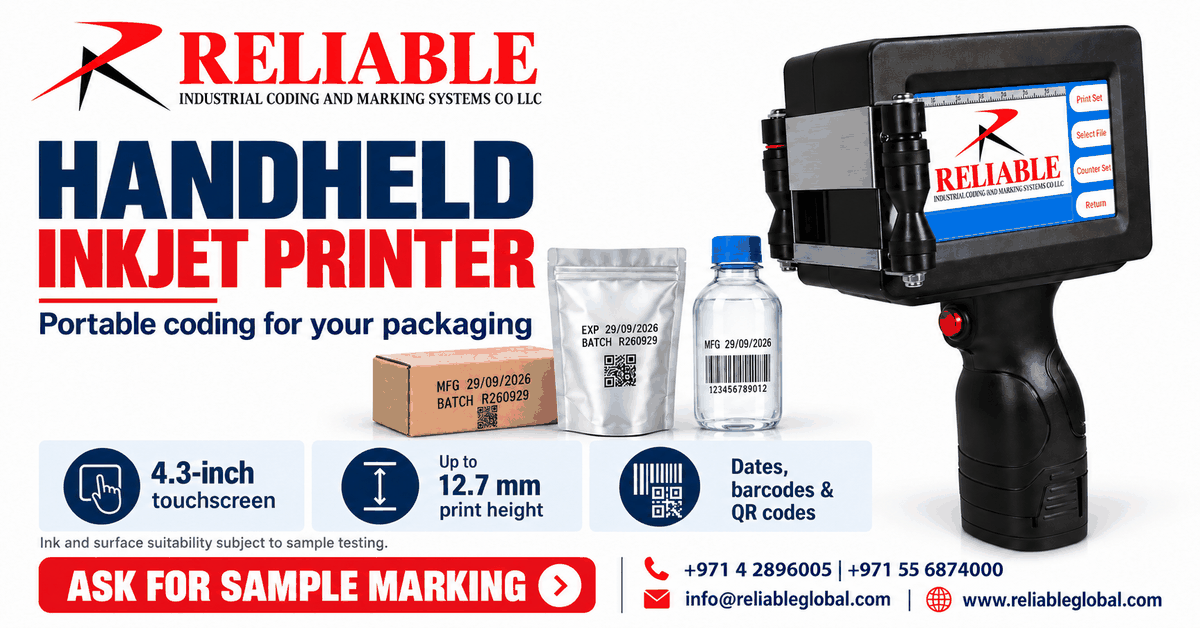
A handheld inkjet printer offers a portable approach to packaging coding. Explore the Reliable solution for dates, batch information and product identification in the UAE. First, share your packaging sample and required message. Then, review the ink and code layout for your application.

Reliable handheld inkjet printer for packaging date and batch coding
Reliable portable coding solution. Packaging examples are illustrative.

Handheld inkjet printer features

The printer features a 4.3-inch touchscreen and a maximum print height of 12.7 mm. It supports text, numbers, dates, times, barcodes, QR codes and Data Matrix codes. In addition, USB connectivity provides an interface for compatible files and workflows.

The interface supports several languages, including English and Arabic. However, confirm your required message format during the demonstration. For example, bring the exact text, symbols and code content that your team intends to use.

Match your ink to the packaging

Choose a handheld inkjet printer setup around the actual surface you need to mark. Cartons, pouches and bottles may need different ink choices and handling methods. Therefore, assess each packaging material separately rather than assuming one setup suits every pack.

Also, identify a suitable coding area. Check for seams, folds, coatings and curved sections. Then, show how operators will support the product while marking it. This helps define a practical method for placing the message consistently.

Test your handheld inkjet printer application

Before selecting a handheld inkjet printer, arrange sample marking on your actual packaging. Check code clarity, drying time and adhesion under normal handling conditions. If your process uses barcodes, include a scan check with the equipment your team normally uses.

Next, confirm that the full message fits within the selected print area. Include the required character size and spacing between lines. Also, describe how many packs operators need to mark during a typical shift. These details help guide the application review.

Ask Reliable for sample marking

Discuss your handheld inkjet printer requirement with Reliable Industrial Coding and Marking Systems Co LLC. Send a packaging sample, the complete code and the desired print position. In addition, share photographs of the work area and any special handling needs.

Finally, review the sample results before confirming the printer and ink combination. Explore our coding and marking solutions, or contact Reliable to discuss your application.

Call: +971 4 2896005
WhatsApp: +971 55 6874000
Email: [email protected]

Confirm final specifications, ink selection and material suitability with your quotation and sample results.

Linx Laser Coders | CSL Series | Reliable UAE

Linx laser coders help manufacturers create permanent product and packaging codes. Explore the CSL Series with Reliable in the UAE. Start with your material, required message and production speed. Then, review the right laser configuration through sample marking.

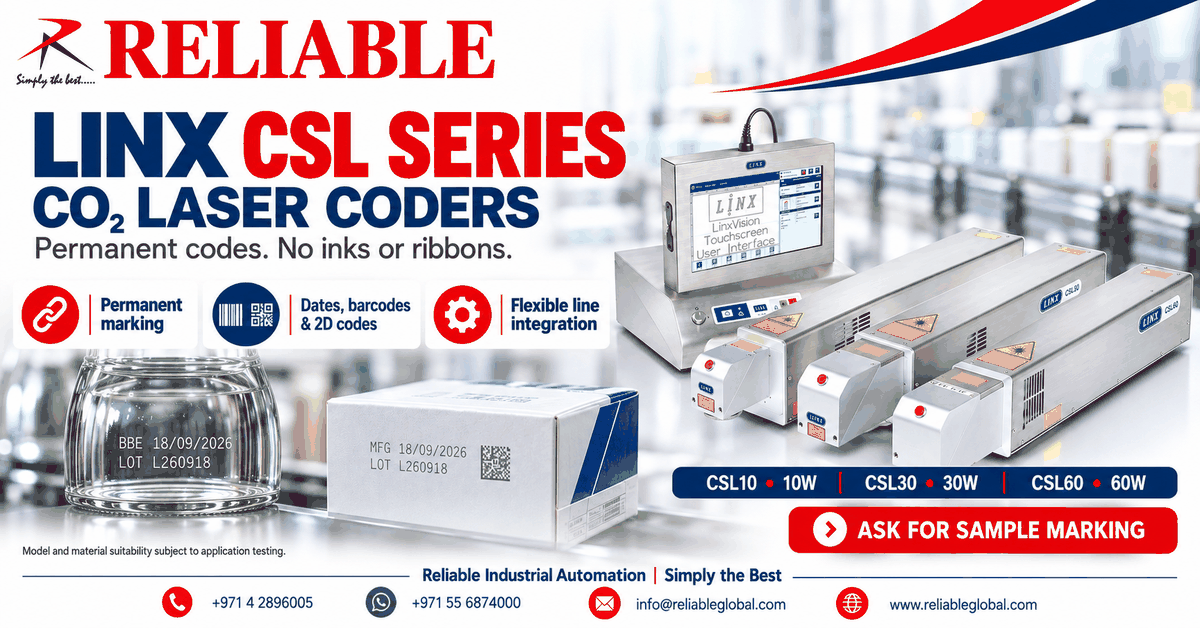
Linx laser coders CSL10 CSL30 and CSL60 with Reliable
Linx CSL Series CO₂ laser coders for permanent marking on suitable materials.

Why choose Linx laser coders?

The CSL Series marks without inks or ribbons. As a result, it removes the need to replenish these coding supplies. The range can produce dates, batch information, text, barcodes, 2D codes and logos. In addition, LinxVision offers a colour touchscreen for managing messages and job settings.

Material suitability matters when choosing Linx laser coders. For example, glass, selected plastics and suitable packaging surfaces can respond differently to the laser. Therefore, test your actual product before choosing a setup. Review code contrast and readability alongside the appearance of the marked surface.

Compare the CSL power options

Linx laser coders in the CSL Series include the 10W CSL10, 30W CSL30 and 60W CSL60. However, power alone does not determine the best choice. The material, message size and available marking time also shape the application. Share these details when requesting a quotation.

Across the range, Linx lists speeds up to 2,100 characters per second and line speeds up to 900 m/min. These are application-dependent maxima. Consequently, confirm achievable performance for your complete code and chosen configuration.

Plan Linx laser coders into your line

Linx laser coders offer different lens and beam-delivery configurations to suit line layouts. First, identify the marking position and available mounting space. Next, share photographs showing how each product passes the coding point. Include any changes in product height or orientation.

Also, review the installation with the appropriate laser guarding, interlocks and fume extraction. Discuss access for operators and maintenance during the layout review. This helps define the complete installation scope before equipment selection.

Ask Reliable for sample marking

To assess Linx laser coders for your application, send Reliable your packaging sample and required message. Include line speed, product spacing and the desired code position. If you use barcodes, also share the scanning requirements.

Then, review the sample under normal handling conditions. Check the code with your team and confirm any scanner results. Finally, agree the model, optics and installation scope before placing an order.

Explore our coding and marking solutions or contact Reliable to discuss Linx laser coders for your project. For manufacturer information, visit the Linx CSL Series product page.

Ask for sample marking: +971 4 2896005 / +971 55 6874000.
Email: [email protected]

Specifications vary by model and application. Confirm material suitability, configuration and regional availability with your quotation.

RYNAN R20 Thermal Inkjet Printer | Reliable UAE

The RYNAN R20 printer range offers thermal inkjet coding with PRO, MAX and REACH printhead options. For example, discuss your packaging coding needs with Reliable in the UAE. Start with your pack material and required code, then choose a configuration that suits the application.

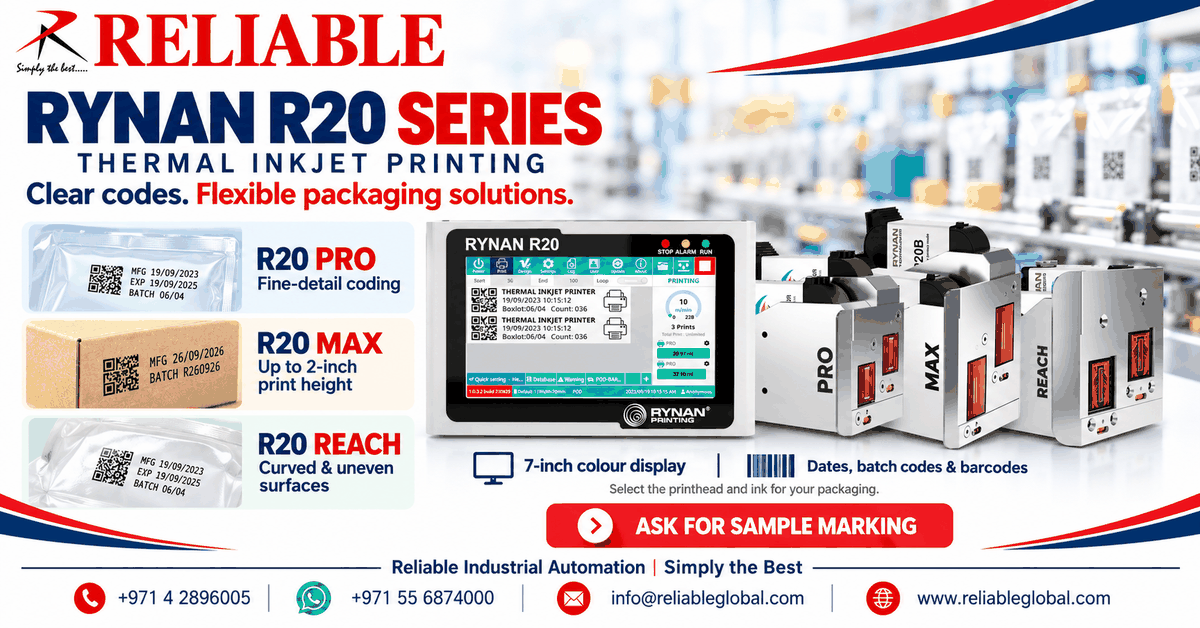
RYNAN R20 printer with PRO MAX and REACH printhead options from Reliable
RYNAN R20 Series: select the printhead and ink for your packaging.

Choose your RYNAN R20 printer

R20 PRO targets small text and variable data on primary packaging. In addition, it supports up to two printheads and offers resolution up to 600 DPI. Meanwhile, R20 MAX targets outer cases and provides print height up to 2 inches (50.8 mm). R20 REACH addresses curved or uneven surfaces with suitable specialist inks.

All three options feature a 7-inch colour display. However, operating specifications differ: PRO and MAX list speeds up to 76 m/min at 300 DPI, while REACH lists up to 45 m/min at 300 DPI. Therefore, confirm the required speed and resolution together when selecting your model.

Match the code to your packaging

The range supports dates, batch codes, barcodes and other variable information. For example, an outer carton may need a larger code than an individual pack. Therefore, share both a packaging sample and the complete message before requesting a quotation.

Also, identify the area where the code must appear. For example, check whether a seam, fold or label crosses this area. Then, provide a photograph showing the product as it travels along the conveyor.

Assess your RYNAN R20 printer application

To review your RYNAN R20 printer requirement, send Reliable the pack dimensions, material and line speed. Include the desired print height, code content and available mounting space. In addition, explain whether the product moves continuously or stops for printing.

Next, arrange sample marking on the actual packaging. Also, check readability, drying and adhesion under your normal handling conditions. If your team scans barcodes, include a scan check in the review. These steps help you assess the proposed ink and printhead before choosing the final setup.

Ask Reliable for sample marking

Discuss your RYNAN R20 printer application with Reliable. Explore our coding and marking solutions, or contact us with your packaging sample and required code. For manufacturer specifications, visit the official RYNAN R20 product page.

Call: +971 4 2896005
WhatsApp: +971 55 6874000
Email: [email protected]

Performance depends on the selected model, printhead, ink and application. Confirm the final configuration and sample results with your quotation.

Linx 9900 Running Costs: Ink and Solvent Saving Options

Linx 9900 running costs deserve a closer look when you review your production coding setup. Reliable Industrial Group can help you assess optional features aimed at reducing ink and solvent consumption. First, share your packaging, required code and production schedule. Then, discuss a suitable configuration for your application.

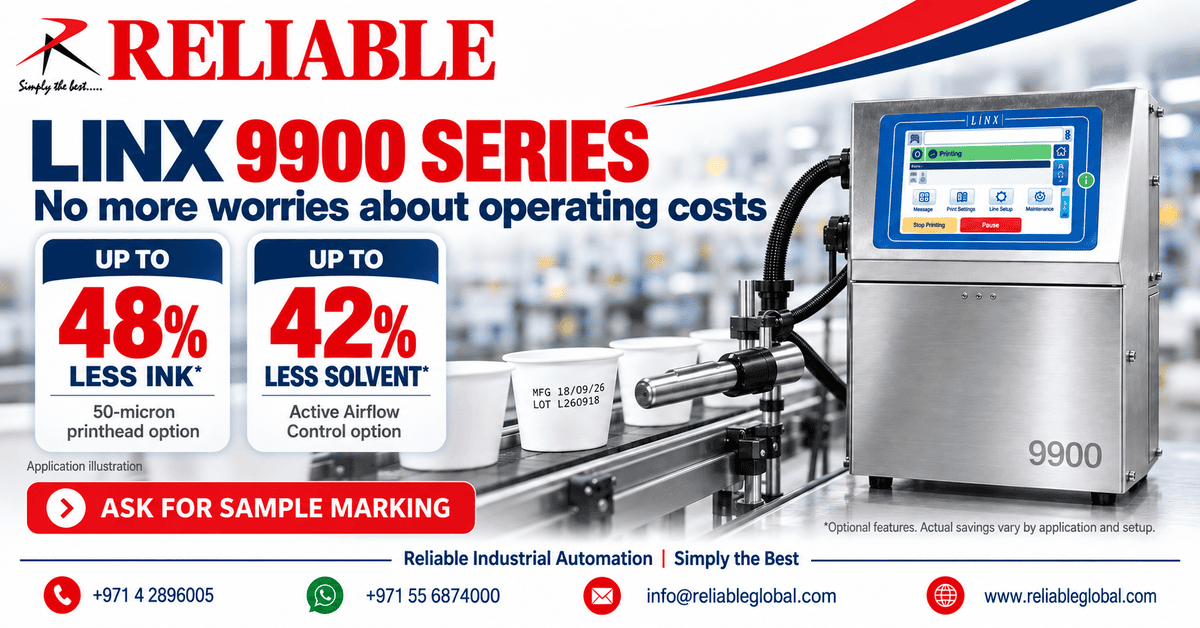
Linx 9900 running costs campaign showing optional ink and solvent savings
LINX 9900 Series: optional features for reduced consumable use. Application illustration; actual savings vary.

Reduce Linx 9900 Running Costs with Optional Features

Linx publishes two consumption-saving figures for its 9000 Series range, which includes the 9900 Series. The optional 50-micron printhead offers up to 48% less ink use. Meanwhile, optional Active Airflow Control offers up to 42% lower solvent use. Therefore, confirm the selected model, ink and option combination before ordering.

Up to 48% Less Ink with the Printhead Option

The 50-micron printhead option targets ink consumption. However, the required code must still suit your packaging and production process. For example, review the message size and readability on a representative sample. Then, assess the proposed setup at your intended line speed.

Linx 9900 Running Costs: Solvent Consumption

Active Airflow Control is a separate option aimed at lowering solvent consumption. As a result, it provides another feature to consider during equipment selection. However, the published maximum is not a guaranteed saving for every production line.

For the original product information, see the Linx 9000 Series overview. In addition, explore our coding and marking solutions to discuss your wider requirements.

Assess Linx 9900 Running Costs on Your Line

Start with your current consumable use and production output over a representative period. Next, record operating hours and the messages you print. Also, note cleaning routines and changes in product mix. These details help define a useful comparison.

For example, compare ink use per thousand equivalent codes and solvent use over comparable operating hours. Keep the code layout and production conditions consistent where possible. Then, review any differences before estimating an annual saving.

The two percentages describe different consumables, so they must not be added together. Similarly, a reduction in consumption is not the same percentage reduction in your total operating bill. Therefore, include consumable prices, option costs and service requirements in your assessment.

What to Send for Sample Marking

  • Packaging material and product photographs
  • Required code and print dimensions
  • Printing position and line speed
  • Daily operating hours
  • Current ink and solvent use, if available
  • Cleaning routines and production conditions

Next, request sample marking to review the proposed code on your product. In addition, ask which optional features are included in the quotation. This makes the equipment scope clear before you proceed.

Frequently Asked Questions

Are both saving features standard?

No. Both features are options. Therefore, ask us to confirm compatibility and include the required options in the proposal.

Will my total running costs fall by either percentage?

Not necessarily. The claims concern ink and solvent consumption separately. Actual financial savings depend on your application, usage and costs.

Does this apply to every configuration?

Confirm the model and configuration during the application review. Also, check regional availability before finalising your order.

Ask for Sample Marking

Ready to review Linx 9900 running costs? Contact Reliable Industrial Group with your product details. Then, request sample marking and a review of suitable ink-saving and solvent-saving options.

Ask for Sample Marking on WhatsApp

Reliable Industrial Group
Telephone: +971 4 2896005
WhatsApp: +971 55 6874000
Email: [email protected]
Website: www.reliableglobal.com

Reliable Industrial Automation | Simply the Best

Industrial Metal Detector in the UAE | Reliable

An industrial metal detector helps identify metal contamination as products move through an inspection point. Reliable Industrial Group offers metal detection solutions in the UAE for production and packaging lines. First, share your product, packaging and inspection requirements. Then, request a product test to assess a suitable setup.

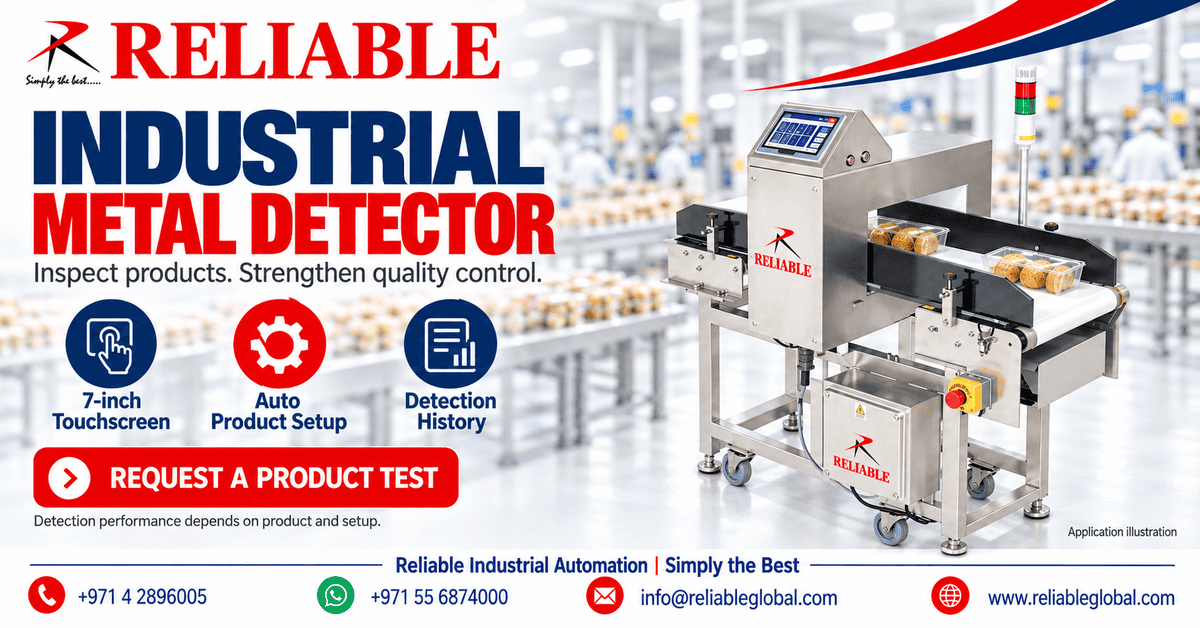
Industrial metal detector with conveyor and touchscreen from Reliable Industrial Group
Reliable metal detection solutions. Application illustration; final configuration depends on your requirements.

Request a Product Test

Industrial Metal Detector Features

The system provides a 7-inch colour touchscreen and automatic product setup. In addition, operators can review detection history and use USB for data management. Multi-frequency operation and digital signal processing support the inspection process.

FeatureFunction
Operator interface7-inch colour touchscreen
Product setupAutomatic setting function
RecordsDetection-history review
Data accessUSB data management

However, automatic setup does not replace performance checks. Before production, confirm the settings and agreed test procedure for each product.

Choosing an Industrial Metal Detector for Your Line

Start by identifying where inspection should take place. For example, you may want to inspect individual packs before they enter an outer carton. Next, confirm the available space and the direction of product travel. Also, record the conveyor height and pack dimensions.

For a wider overview, explore our weighing and inspection equipment. Then, discuss how metal detection should fit into your existing quality checks.

Why Product Testing Matters

An industrial metal detector needs an application-specific performance target. Therefore, provide representative samples in their normal packaging. Include the largest pack and any product variants you intend to run. In addition, tell us about changes in temperature or product condition during production.

During the trial, agree the test materials, sizes and positions to evaluate. Next, record the settings and results for review. As a result, your team can assess the proposed setup against a defined requirement.

A detector should form part of a wider contamination-control process. For instance, equipment maintenance, handling practices and investigation of rejected products remain necessary. Therefore, avoid treating a successful trial as a guarantee that every possible contaminant will be detected.

Industrial Metal Detector Application Checklist

To prepare a useful assessment, send the following details:

  • Product description and photographs
  • Packaging material, including any foil or metallised layers
  • Maximum pack width, height, length and weight
  • Line speed and packs per minute
  • Required detection targets and test-piece information
  • Conveyor height, available space and product direction
  • Required alarm, stop or rejection response
  • Cleaning conditions and data-recording needs

Also, explain how your team will handle a detection event. For example, identify where suspect products should be held and who will review them. Then, include these steps in the application discussion.

Frequently Asked Questions

Can an industrial metal detector inspect my packaging?

Packaging suitability requires a product review. In particular, declare foil and metallised materials before selecting equipment. Then, arrange a test using your actual pack.

What detection size can I expect?

We do not quote one sensitivity figure for every product. Instead, share your required targets so the proposed setup can be evaluated under representative conditions.

Is automatic rejection included?

Confirm the required response in your enquiry. For example, your process may need an alarm, a conveyor stop or a separate reject arrangement. The quotation should specify what is included.

Request Your Product Test

Looking for an industrial metal detector in the UAE? Contact Reliable Industrial Group with your samples and production details. Next, request an application review and product test before finalising the equipment configuration.

Reliable Industrial Group
Telephone: +971 4 2896005
WhatsApp: +971 55 6874000
Email: [email protected]
Website: www.reliableglobal.com

Reliable Industrial Automation | Simply the Best

Automatic Checkweigher in the UAE | Reliable

An automatic checkweigher checks product weight as packs move along a production line. Reliable Industrial Group offers checkweighing solutions in the UAE for packaged goods. First, share your product size, target weight and line speed. Then, we can review the right conveyor layout and rejection method for your application.

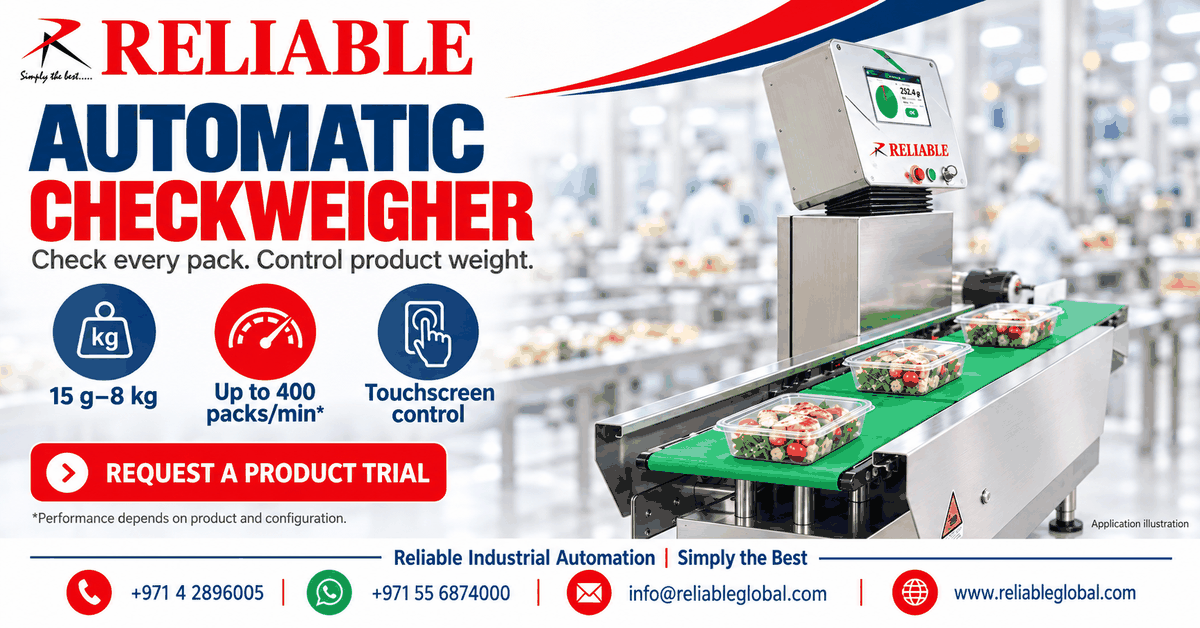
Automatic checkweigher for packaged products from Reliable Industrial Group
Reliable checkweighing solutions. Application illustration; final configuration varies.

Request a Product Trial

Why Use an Automatic Checkweigher?

Weight checks help production teams spot packs outside the selected limits. For example, an underweight pack may indicate a filling issue. An overweight pack, meanwhile, may mean unnecessary product giveaway. Therefore, checking weight during production provides useful feedback before goods leave the line.

However, weight alone does not confirm every aspect of product quality. It should form part of a wider inspection process. For instance, damaged packaging and incorrect labels need their own checks.

Compact Checkweighing for Packaged Products

This configuration range covers products from 15 g to 8 kg, with throughput up to 400 packs per minute. In addition, its modular structure supports integration with marking, vision and barcode systems. Touchscreen options include 7, 10 and 15 inches.

FeatureAvailable specification
Product weight range15 g to 8 kg
Maximum throughputUp to 400 packs per minute
Conveyors1 to 6, depending on configuration
ProtectionIP54; IP65 optional
Product handlingBags, trays, boxes, bottles, cans and jars, subject to application review

Actual performance depends on product shape, size, weight and line conditions. Therefore, the maximum speed and full weight range should not be treated as simultaneous guarantees. We recommend confirming the required performance with representative samples.

Rejection Options for Your Production Line

Available rejection arrangements include air jets, pushers, diverters and drop-down systems. However, the choice depends on pack stability and handling needs. For example, a fragile pack may need a different approach from a rigid carton. Optional safety devices include reject confirmation, bin-full detection and audible-visual alarms.

How to Specify Your Automatic Checkweigher

Start with the smallest and largest products you expect to run. Next, record the conveyor height and available installation space. Also, confirm how products arrive at the weighing section and where rejected packs should go.

  • Product photograph and packaging type
  • Minimum, target and maximum pack weight
  • Pack length, width and height
  • Required packs per minute
  • Weight tolerance and rejection requirements
  • Conveyor height, direction and available space
  • Cleaning conditions and communication needs

These details help define a useful trial. During evaluation, include normal variations in fill, pack position and spacing. As a result, the review can reflect everyday production more closely.

Frequently Asked Questions

Can it check outer boxes?

Boxes are a supported packaging format. However, the box weight, dimensions and line speed must suit the selected configuration. Send these details for review before choosing a system.

Does every application reach 400 packs per minute?

No. This is a maximum range figure. Actual throughput depends on the product and selected arrangement, so confirm it during application assessment.

Is IP65 included as standard?

No. The listed standard protection is IP54, while IP65 is optional. Therefore, describe your cleaning process when requesting a quotation.

Discuss Your Checkweigher Application

Looking for an automatic checkweigher in the UAE? Send your product details to Reliable Industrial Group. Then, request an application review and product trial to assess the proposed setup.

Reliable Industrial Group
Telephone: +971 4 2896005
WhatsApp: +971 55 6874000
Email: [email protected]
Website: www.reliableglobal.com

Reliable Industrial Automation | Simply the Best

Bench Scales, Floor Scales & Platform Scales in UAE

Reliable Industrial Group supplies bench scales, floor scales and platform scales in the UAE for production, packing and warehouse operations. From small components to loaded pallets, we help you match the scale to your product, working area and required weighing capacity. As a result, your team can build a clearer weighing process from goods receipt to dispatch.

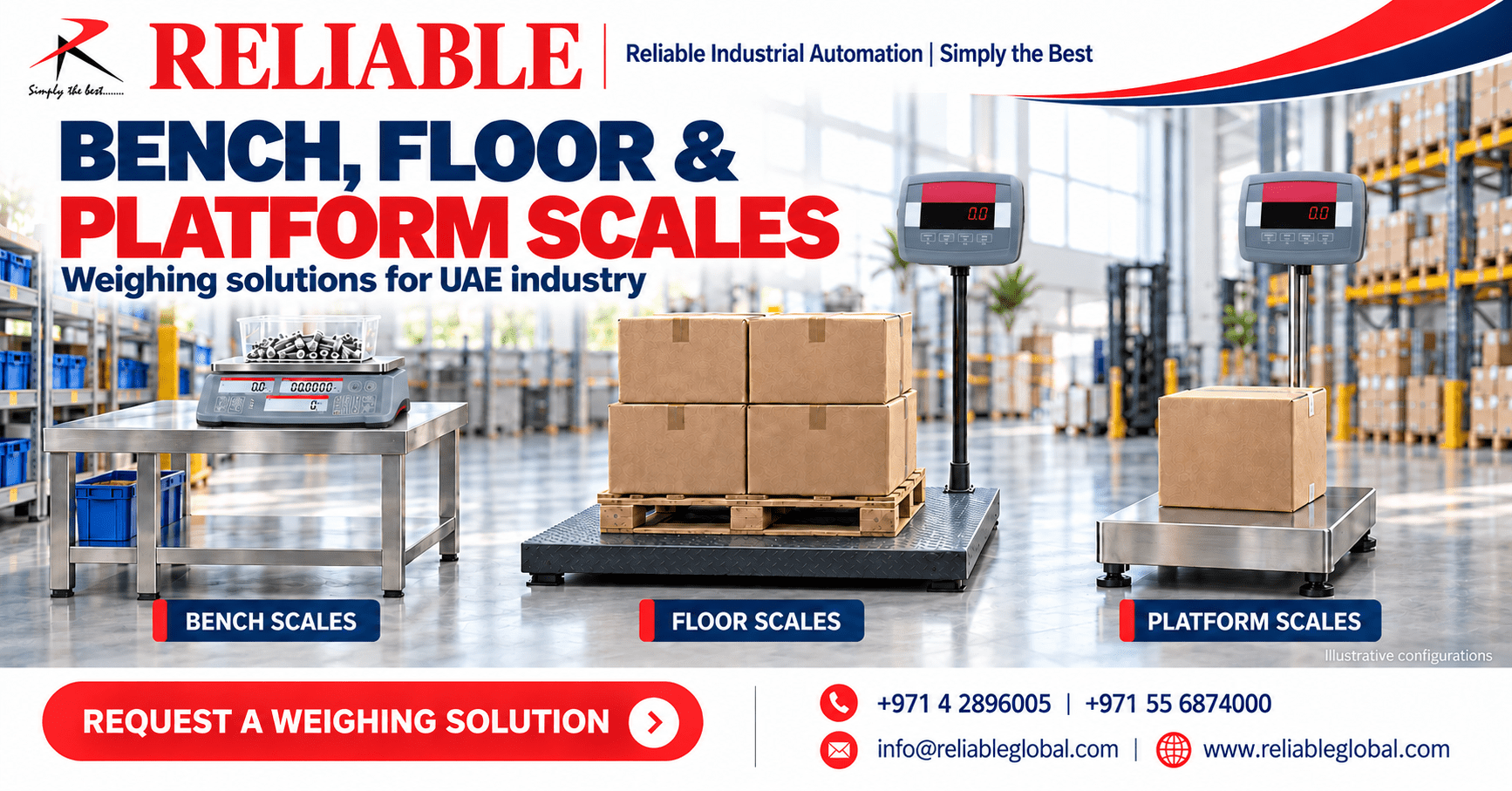
Illustration of bench scales, floor scales and platform scales for Reliable Industrial Group in the UAE
Bench, floor and platform weighing solutions for UAE industry. Illustrative configurations; the supplied equipment depends on your selected model.

Bench scales for packing and parts counting

Bench scales suit weighing tasks at workstations, packing tables and production areas. For example, operators can weigh ingredients, check packed goods or prepare small orders. A compact weighing surface also helps make good use of the available workspace.

For stock control, a suitable counting model estimates the number of similar parts from their average piece weight. First, the operator weighs a representative sample. Then, the scale uses that reference to calculate the count. However, variations between parts can affect the result, so sample selection and suitable resolution matter.

Floor scales for pallets, drums and bulk goods

Floor scales provide a practical weighing point for larger loads in receiving, storage and dispatch areas. For instance, a low-profile deck can support pallet or drum weighing when its size and capacity suit the load. The indicator can sit where operators can read it clearly.

Depending on the installation, options may include access ramps or a pit-mounted arrangement. Before selecting either, check the loading method, floor condition and available approach space. In addition, the load must rest fully on the weighing platform without touching nearby structures.

Platform scales for everyday industrial weighing

Platform scales combine a weighing deck with a suitable weight indicator. They can serve packing stations, production areas and stores handling cartons, sacks or containers. Also, different deck sizes help accommodate the footprint of the goods.

Floor and platform categories often overlap; a floor scale is usually a platform scale intended for use at floor level. Therefore, choose the equipment by its application rather than its category name alone. Reliable can review the deck size, capacity and indicator position for your workflow.

Choose the right capacity and platform size

Start with the maximum combined weight of the goods and their pallet, tray or container. Next, identify the smallest weight change your process needs to detect. A higher capacity does not automatically provide finer measurement.

Share the load dimensions as well as its weight. For example, a wide carton may need a larger deck even when it is relatively light. Also, explain how staff will place and remove each load, including any trolley or pallet handling requirements.

Match the construction to your environment

Dry warehouses and wet processing areas need different equipment choices. For routine dry use, a suitable steel construction may meet the application. By comparison, wet or frequently cleaned areas may require stainless steel and a suitable washdown rating.

However, stainless steel alone does not make a complete scale waterproof. Check the protection of the indicator, load cells, connections and enclosure. Therefore, tell our team about water exposure, cleaning chemicals and the cleaning method before choosing a model.

Useful functions for daily operation

Select the functions that support your actual process. Depending on the model and configuration, these can include:

  • Tare and net weighing: account for a container before weighing its contents.
  • Parts counting: estimate quantities of similar items from a sample weight.
  • Checkweighing: compare a stationary load with a chosen target range.
  • Totalisation: add several weighing results within a supported workflow.
  • Printing or data transfer: use compatible interfaces and accessories where available.

For example, bench scales with counting functions can support stock preparation. Meanwhile, floor scales with a compatible printer can help record dispatch weights. Confirm the selected functions and connections in your quotation.

Applications across UAE industry

Reliable supports weighing requirements in manufacturing, food packing, engineering stores and logistics. For example, a workshop may need bench scales for small components, while a warehouse may need floor scales for outgoing pallets.

Similarly, platform scales can support carton checks or material weighing near a production station. By matching each weighing point to its task, operators can avoid unnecessary movement between work areas. Explore our wider weighing equipment range for related applications.

Selection, calibration and service support

Reliable can assist with equipment selection and discuss calibration, repair and maintenance needs. First, share your operating conditions and weighing requirements. Then, our team can review a suitable configuration and the required support.

For existing equipment, also provide the model, capacity and a photograph of the installation. This information helps us understand the current setup before recommending the next step. Learn more about our weighing and service capabilities.

What should you send for a quotation?

To request bench scales, floor scales or platform scales, please provide:

  • The product or material you want to weigh.
  • Maximum load, including its container, and required readability.
  • Load dimensions and preferred platform size.
  • Dry, dusty, wet or washdown operating conditions.
  • Required counting, checkweighing, printing or data connections.
  • Quantity, installation location and photographs of the working area.

Request a weighing solution

Contact Reliable Industrial Group for a weighing solution that suits your application. Share your capacity, platform size and daily workflow so our UAE team can prepare a relevant proposal.

Request a Weighing Solution on WhatsApp

Telephone: +971 4 2896005
WhatsApp: +971 55 6874000
Email: [email protected]
Website: www.reliableglobal.com

Reliable Industrial Automation | Simply the Best

Bottle Coding Machine Solutions in the UAE

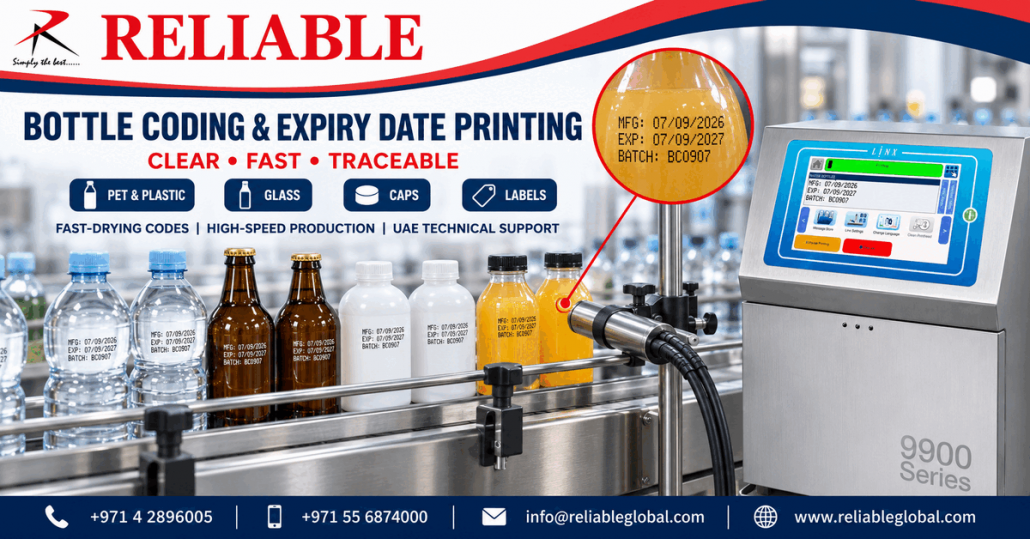
Linx 9900 bottle coding machine printing expiry dates on plastic and glass bottles in UAE

Reliable Industrial Group supplies bottle coding machine solutions in the UAE for clear manufacturing dates, expiry dates, batch numbers and traceability codes on plastic and glass bottles. Our industrial coding systems integrate with filling, capping and labelling lines while maintaining accurate code placement at production speed.

Bottles create special printing challenges because they have curved surfaces, limited coding areas and many different materials. In addition, beverage and food production areas may include moisture, condensation or frequent cleaning. Therefore, our team reviews the bottle, code, line speed and working environment before recommending the most suitable printer, ink and installation method.

What Is a Bottle Coding Machine?

A bottle coding machine prints variable information directly onto a bottle, cap or label during production. Typical messages include manufacturing dates, expiry or best-before dates, batch numbers, lot numbers, time codes, serial numbers, barcodes, QR codes and Data Matrix codes.

Unlike pre-printed packaging, an industrial coder updates variable information automatically for each production batch. As a result, manufacturers can improve traceability, reduce packaging waste and change messages without ordering new labels or bottles.

Bottle Coding Machine Applications

Expiry Date Printing on PET and Plastic Bottles

PET, HDPE, PE, PP and PVC containers are common in water, beverage, dairy, chemical, cosmetic and household-product manufacturing. However, these non-porous surfaces require the correct ink and printer setup. A suitable continuous inkjet system produces a fast-drying code with good contrast and adhesion.

The printhead can apply the code to the bottle body, shoulder, neck, base or label. Moreover, non-contact printing allows the system to mark curved surfaces without touching or damaging the container.

Batch and Date Coding on Glass Bottles

Glass bottles may be clear, amber, green or coated. Consequently, the required code colour and ink type can vary. Beverage producers may also need codes that survive refrigeration, handling or pasteurisation. In contrast, returnable-bottle applications may require washable ink that remains secure during distribution but can be removed during the bottle-washing process.

Reliable Industrial Group can review the glass type, bottle temperature and post-print process before selecting the coding method.

Printing on Bottle Caps

Some products require the manufacturing date, expiry date or batch code on the cap instead of the bottle body. Cap printing needs accurate product detection because the available marking area is small. Therefore, correct sensor positioning, printhead mounting and message size are essential.

Depending on the closure, the system can code plastic caps, metal caps or cap edges. A compact printhead also makes integration easier where production space is limited.

Coding on Bottle Labels

A coder can print onto the label before or after application. This arrangement allows manufacturers to combine product branding with variable information in one clear area. In addition, coding equipment can integrate with automatic labelling machines for consistent position and production speed.

Linx 9900 Bottle Coding Machine

The Linx 9900 Series continuous inkjet printer provides a practical solution for high-volume bottle coding. Its industrial stainless-steel construction, touchscreen interface and flexible printhead installation support demanding production environments. Furthermore, the coder can print multiple lines of variable text and machine-readable codes, depending on the selected configuration.

Compact and right-angle printhead options help installers position the coder around filling, capping and labelling equipment. In addition, print synchronisation can maintain code quality when conveyor speed changes. These features make the Linx 9900 suitable for manufacturers that need reliable coding without slowing the bottling line.

Realistic, Readable Expiry Date Codes

A good bottle code should be small enough for the available area but large enough for operators and customers to read. It must also follow the bottle surface without excessive distortion. For this reason, our team considers character height, print distance, printhead angle, bottle movement and conveyor stability.

A typical three-line message may include:

MFG: 07/09/2026
EXP: 07/09/2027
BATCH: BC0907

Before installation, sample printing helps confirm contrast, drying time and adhesion. Therefore, customers can evaluate the actual result on their bottle instead of relying only on general specifications.

How Bottle Coding Works on a Production Line

  1. A product sensor detects each approaching bottle.
  2. The encoder or line signal communicates the production speed.
  3. The controller selects the approved coding message.
  4. The printhead applies ink droplets without contacting the bottle.
  5. The code dries as the bottle continues along the conveyor.
  6. An optional vision system checks presence, position and readability.

Correct mounting prevents vibration and keeps the printhead at a stable distance from the product. Meanwhile, suitable conveyor guides control bottle movement so the code appears in the same area on every container.

Benefits of Industrial Bottle Coding

  • Clear traceability: Manufacturing, expiry and batch information supports product identification.
  • High-speed printing: Non-contact coding suits continuous bottling operations.
  • Flexible code content: Operators can update dates, batches, shifts and other variable information.
  • Multiple bottle materials: Suitable technologies are available for plastic, glass, labels and caps.
  • Fast-drying options: Correct inks help prevent smudging on non-porous surfaces.
  • Compact integration: Flexible printheads fit around existing conveyors and packaging machines.
  • Reduced packaging waste: Variable information can be printed during production.
  • Vision inspection options: Automated checks can confirm that the required code is present.

Selecting the Right Bottle Coding Machine

First, identify the bottle material and the exact area that needs coding. Next, confirm the required message, character height, number of lines and code colour. Production speed, bottle spacing and conveyor stability also affect the final selection.

The working environment is equally important. For example, a cold-fill beverage line may create condensation, while a chemical facility may contain dust or solvent vapours. Furthermore, cleaning procedures and temperature changes can affect ink performance and printer protection requirements.

Customers should also consider the required code durability. Some applications need permanent identification, while returnable glass bottles may require removable codes. By sharing product samples and production details, customers help us recommend a bottle coding machine that matches the real application.

Industries Using Bottle Coding Systems

Bottle coding supports many manufacturing sectors across Dubai, Abu Dhabi, Sharjah and the wider UAE. Common applications include:

  • Bottled water and soft drinks
  • Juice, dairy and edible oil
  • Sauces, syrups and liquid foods
  • Pharmaceutical and healthcare products
  • Perfumes, cosmetics and personal care
  • Cleaning chemicals and detergents
  • Lubricants and automotive fluids
  • Household and FMCG products

Installation and Technical Support in the UAE

Reliable performance depends on more than the printer itself. Therefore, our service includes application review, sample testing, printhead mounting, sensor positioning, message setup and operator training. We can also help integrate the coder with conveyors, labellers and production-control systems.

After commissioning, routine cleaning and preventive maintenance help protect print quality and uptime. Reliable Industrial Group provides local technical assistance, consumables and service support for industrial coding customers across the UAE.

Frequently Asked Questions

Which machine is suitable for expiry date printing on bottles?

A continuous inkjet printer is a common choice for high-speed plastic and glass bottle lines. However, the best technology depends on the bottle material, required code, production environment and desired permanence.

Can a bottle coding machine print on curved surfaces?

Yes. Non-contact coding systems can print on curved bottle surfaces. Correct print distance, bottle guidance and character size help prevent distortion.

Can the printer code wet or cold bottles?

Suitable inks and printer configurations can support demanding beverage environments. Nevertheless, heavy condensation may require an air knife or another method to clear the coding area before printing.

Can the same printer code different bottle sizes?

Yes. Many systems can handle multiple formats after adjustments to the guides, sensor, printhead position and message settings.

Can codes be printed on bottle caps and labels?

Yes. The coder can print on suitable plastic or metal caps and on many label materials. Sample testing confirms the best ink, position and code size.

What details are required for a quotation?

Please provide bottle samples or photographs, material type, code content, production speed, conveyor details, working conditions and the required coding position.

Request a Bottle Coding Machine Quotation

Looking for a bottle coding machine in the UAE? Contact Reliable Industrial Group for expiry date, manufacturing date and batch coding solutions for PET, plastic and glass bottles. Our team will help you select the correct printer, ink, printhead and mounting arrangement for your production line.

Telephone: +971 4 2896005
Mobile/WhatsApp: +971 55 6874000
Email: [email protected]
Website: www.reliableglobal.com
Contact: Speak with our UAE coding specialists

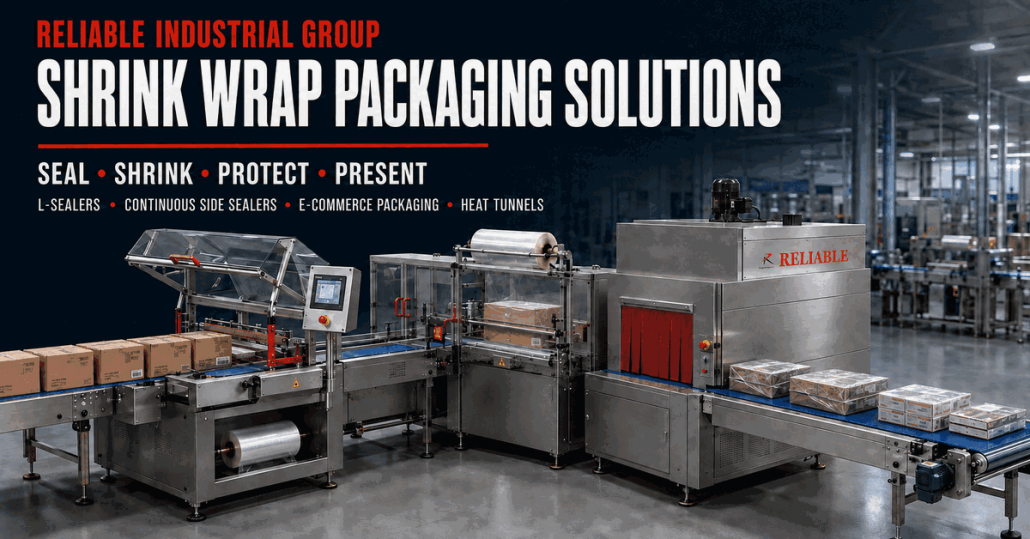
Shrink wrap packaging machines in UAE with L-sealer, continuous side sealer and heat tunnel

Shrink Wrap Packaging Machines in the UAE

Shrink wrap packaging machines in UAE with L-sealer, continuous side sealer and heat tunnel

Seal, shrink, protect and present products with reliable automated packaging solutions.

Reliable Industrial Group supplies shrink wrap packaging machines for manufacturers, warehouses, distribution centres and e-commerce operations across the UAE. Our solutions include L-sealers, continuous side sealers, automated e-commerce packaging machines and heat-shrink tunnels for products of different sizes and production speeds.

Shrink wrapping creates a clean and protective film layer around a product or group of products. Therefore, businesses can improve product protection, presentation and handling while reducing manual packing work. In addition, the correct system can connect directly to an existing conveyor or production line.

How Shrink Wrap Packaging Works

A typical shrink-wrapping process starts when the operator or conveyor feeds a product into centre-folded film. Next, the sealing system closes and cuts the film around the product. The sealed pack then moves through a heat tunnel, where controlled hot air shrinks the film evenly around its surface. Finally, the finished package exits the tunnel ready for handling, storage or dispatch.

However, the correct process depends on the product size, film type, required speed and final appearance. For example, a small batch operation may need a compact L-sealer, while a high-output line may require a fully automatic continuous side sealer and separate heat tunnel.

Our Shrink Wrap Packaging Solutions

L-Sealers for Flexible Shrink Wrapping

An L-sealer forms two seals around the open sides of centre-folded film. As a result, it creates a closed film bag around each product before the pack enters the heat tunnel.

Semi-automatic L-sealers suit low and medium production volumes, frequent product changes and a wide variety of product shapes. Moreover, digital controls allow operators to adjust sealing heat, conveyor time and tunnel settings for different film thicknesses and product dimensions.

L-sealers can pack books, stationery, cosmetic cartons, food trays, gift boxes, household products and many other retail items. Therefore, they provide a practical solution for businesses that need flexibility without a fully automatic high-speed line.

Continuous Side Sealers for Higher Production Speeds

Continuous side sealers wrap and seal products while the conveyor remains in motion. Consequently, these machines support higher production speeds and smooth product flow. They can also handle products with different lengths because the side-sealing process does not rely on one fixed bag length.

Servo-controlled sealing, automatic film feeding and encoder-based product tracking help maintain accurate seals. In addition, recipe storage and touchscreen controls make product changeovers faster and easier.

Continuous side sealers suit food products, printed materials, cosmetics, household goods, electronics, spare parts and industrial components. They can operate as standalone machines or connect directly to an upstream production line and downstream shrink tunnel.

E-Commerce Packaging Machines

E-commerce packaging machines automate parcel wrapping for products with changing lengths. First, sensors detect the incoming product. Then, the machine adjusts the package length, seals the film and prepares the parcel for dispatch.

Depending on the configuration, the system can also connect to a barcode reader, checkweigher, print-and-apply labeler or warehouse management system. As a result, businesses can combine product identification, packaging and shipping-label application in one process.

This approach reduces manual packing time and improves consistency during busy order periods. Moreover, fit-to-length packaging can reduce excess material around smaller products.

Heat-Shrink Tunnels

A heat tunnel circulates controlled hot air around a sealed film package. Therefore, the film shrinks closely and evenly around the product. Adjustable temperature, airflow and conveyor speed help operators achieve the required finish for different products and films.

Modern heat tunnels can include digital temperature control, adjustable airflow, automatic cooling and different conveyor options. In addition, insulated tunnel construction can improve heat control and reduce energy loss.

Heat tunnels can connect to L-sealers, continuous side sealers, sleeve wrappers and other packaging systems. However, the tunnel opening, chamber length and conveyor type must suit the product dimensions and required production speed.

Shrink-Wrapping Process

  1. Product infeed: the operator or conveyor introduces the product to the packaging line.
  2. Film wrapping: centre-folded film surrounds the product.
  3. Film sealing: the machine closes and cuts the film around the pack.
  4. Heat shrinking: controlled hot air shrinks the film evenly.
  5. Finished pack: the protected package exits for storage, handling or dispatch.

Benefits of Shrink Wrap Packaging Machines

  • Product protection: film helps protect products from dust, moisture and handling marks.
  • Neat presentation: tight and transparent wrapping improves retail appearance.
  • Tamper evidence: a sealed film layer makes package opening more noticeable.
  • Higher efficiency: automated sealing and shrinking reduce manual packing work.
  • Flexible formats: one system can handle several product sizes within its operating range.
  • Reduced material use: correct machine settings help control film consumption.
  • Easy integration: machines can connect to conveyors, labellers and production equipment.
  • Consistent results: controlled heat, speed and sealing improve pack quality.

Products Suitable for Shrink Wrapping

Shrink wrapping supports many products in Dubai, Abu Dhabi, Sharjah and across the UAE. For example, common applications include:

  • Food trays, bakery items and multipacks
  • Beverage containers and grouped products
  • Cosmetic, perfume and personal-care cartons
  • Books, stationery and printed materials
  • Household products and cleaning supplies
  • Electronics, accessories and spare parts
  • Medical and pharmaceutical cartons
  • E-commerce parcels and fulfilment orders
  • Promotional packs and retail bundles
  • Industrial components and hardware

Choosing the Correct Shrink Film

Film selection affects seal quality, package strength, appearance and tunnel settings. Polyolefin film often provides a clear retail finish and suits many consumer products. However, polyethylene film may suit heavier packs, grouped products or applications that need stronger film.

Before selecting a film, confirm the product weight, sharp edges, heat sensitivity, required strength and final appearance. In addition, test the chosen film with the actual machine and product because sealing and shrinking results can vary.

How to Select the Right Shrink-Wrapping Machine

Consider the following details before requesting a quotation:

  1. Product dimensions: provide the minimum and maximum width, length and height.
  2. Product weight: confirm the heaviest pack that will travel on the conveyor.
  3. Required output: state the target packs per minute or parcels per hour.
  4. Film type: identify POF, PE, PVC or another required packaging film.
  5. Operation level: choose manual, semi-automatic or fully automatic packing.
  6. Product variation: explain how often product sizes change during production.
  7. Line integration: list upstream conveyors and downstream packing equipment.
  8. Working conditions: identify moisture, washdown, dust, heat or space limits.
  9. Additional functions: confirm barcode reading, labelling, weighing or software needs.

Providing these details helps our team recommend the correct sealer, tunnel opening, conveyor size and control system. Therefore, customers receive a solution that matches the real product and production target.

Integration with Packaging and Production Lines

A shrink-wrapping machine can work as a standalone packing station or as part of a complete line. For example, businesses can connect it to product feeders, conveyors, checkweighers, date coders, label applicators, cartoning systems and palletising equipment.

In addition, e-commerce systems can connect to barcode databases, warehouse software and print-and-apply labellers. This integration reduces manual data entry and helps prepare parcels for shipping more efficiently.

Installation and Support in the UAE

Correct installation helps the machine seal consistently and maintain smooth product flow. First, technicians confirm the electrical supply, compressed-air needs and available floor space. Next, they align the conveyors and set the film path. Finally, they test sealing temperature, tunnel heat, airflow and conveyor speed with the actual product.

Reliable Industrial Group supports customers with machine selection, installation, commissioning, operator guidance and after-sales service. Moreover, our team can review existing packing lines that need higher speed, better film control or improved integration.

Why Choose Reliable Industrial Group?

Reliable Industrial Group combines packaging experience with local UAE support. Therefore, we focus on the complete application instead of offering only a standalone machine. We review the product, film, target speed, available space and required line connections before recommending a solution.

From a compact L-sealer to a fully automatic continuous side-sealing line or e-commerce packaging system, we help customers improve product protection, presentation and packing efficiency.

Explore more solutions from Reliable Industrial Group or contact our UAE packaging specialists to discuss your application.

Frequently Asked Questions

What is a shrink wrap packaging machine?

A shrink wrap packaging machine surrounds a product with film, seals the film and then uses controlled heat to shrink it around the product. Therefore, the finished pack gains a tight protective layer and a neat appearance.

What is the difference between an L-sealer and a continuous side sealer?

An L-sealer creates two seals during each sealing cycle and suits flexible low-to-medium output. However, a continuous side sealer seals products while they move, so it better suits higher production speeds and products with different lengths.

Do I need a separate heat tunnel?

Most L-sealer and side-sealer systems need a heat tunnel to shrink the sealed film. Some compact machines combine sealing and shrinking in one frame, while other lines use a separate tunnel.

Which products can be shrink wrapped?

Businesses can shrink wrap cartons, books, food trays, cosmetic boxes, bottles, printed materials, spare parts and many other stable products. However, heat-sensitive products require careful testing and suitable tunnel settings.

Can the system handle different product sizes?

Yes. Many machines allow format changes for different widths, lengths and heights. In addition, automatic systems can detect product length and adjust the package accordingly.

Can shrink-wrapping machines connect to existing production lines?

Yes. The machines can connect to upstream and downstream conveyors when the working height, speed, product spacing and control signals match.

What information is required for a quotation?

Please provide product photographs, minimum and maximum dimensions, weight, required packs per minute, film type, power supply, available space and any conveyor or software integration requirements.

Request a Shrink Wrap Packaging Machine Quotation

Looking for an L-sealer, continuous side sealer, e-commerce packaging machine or heat tunnel in the UAE? Contact Reliable Industrial Group for help selecting the correct packaging solution.

Telephone: +971 4 2896005
Mobile / WhatsApp: +971 55 6874000
Email: [email protected]
Website: www.reliableglobal.com

industrial weighing scales

Industrial weighing scales

Accurate, reliable and durable weighing solutions for production, warehousing and logistics.

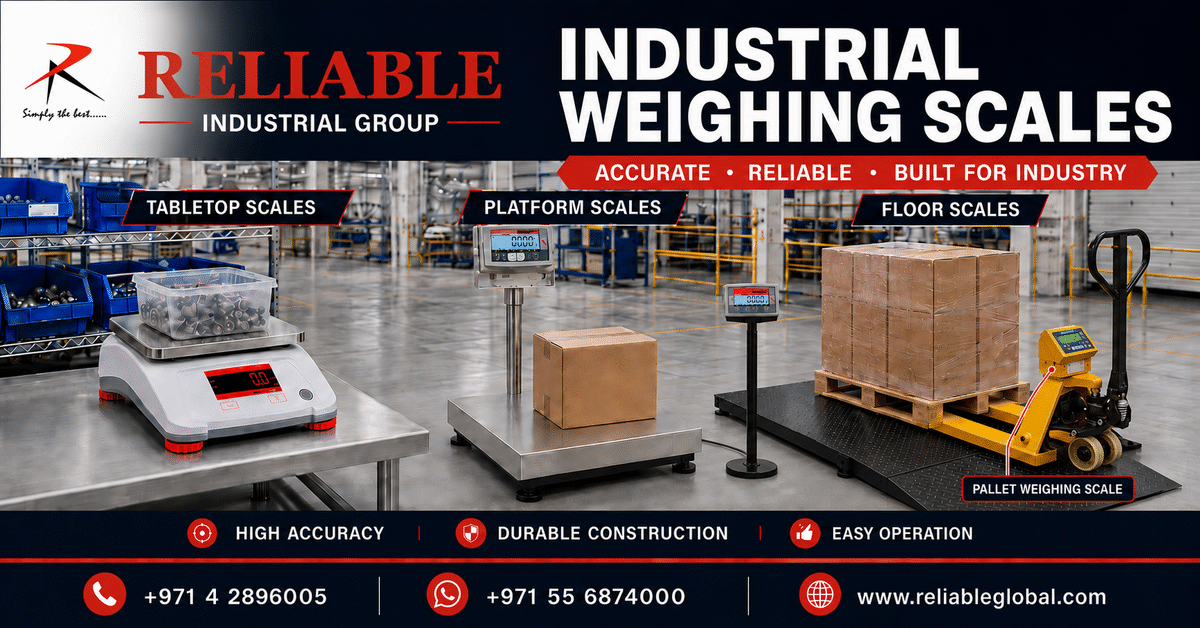
Industrial weighing scales in UAE including tabletop, platform and floor scales
Tabletop, platform and floor scales for industrial weighing applications in the UAE.

Reliable Industrial Group supplies industrial weighing scales for factories, warehouses, food-processing facilities, laboratories, distribution centres and logistics operations throughout the UAE. Our range includes tabletop scales, bench scales, counting scales, platform scales and heavy-duty floor scales for everything from small components to palletised goods.

The correct weighing equipment improves accuracy, reduces product giveaway, supports stock control and helps operators work faster. Therefore, we help customers select a scale based on capacity, readability, platform size, working conditions, required functions and data needs. In addition, our team supports installation, calibration, setup and connection to printers, computers or business systems.

Industrial Weighing Scales for Different Applications

No single scale suits every process. For example, a parts-counting station may need high readability and a compact stainless-steel platform. However, a warehouse dispatch area may need a low-profile floor scale with pallet-truck ramps. As a result, the correct model protects accuracy and prevents excess wear.

Tabletop and Bench Scales

Operators use a tabletop scale, also called a bench scale, for light and medium loads on a workbench, packing table or production station. Because it has a compact footprint, it suits ingredient preparation, portion control, quality checks, order packing and component counting.

Depending on the application, tabletop scales can provide tare, zero, unit conversion, checkweighing, total weight and piece-counting functions. In addition, stainless-steel or washdown models suit sites that clean equipment often, including food, beverage, pharmaceutical and chemical plants.

Platform Scales

Platform scales provide a larger weighing surface and higher capacity than most tabletop models. Therefore, factories commonly use them for cartons, sacks, crates, drums and production materials. Installers can mount the display on a column, wall or separate desk stand, so the operator can read the result without blocking the load.

These industrial weighing scales come in different platform sizes, capacities and graduations. Moreover, customers can choose stainless-steel construction, checkweighing limits, counting, total weight, label or ticket printing and digital links to production or warehouse software.

Floor Scales and Pallet Weighing

Heavy-duty floor scales handle larger items such as pallets, containers, bulk bags and loaded trolleys. Installers can place a low-profile platform above ground with access ramps or fit it into a pit for a flush surface. As a result, operators can load goods with a pallet truck, trolley or forklift when the platform design allows it.

A correctly specified floor scale helps warehouses check incoming goods, control dispatch weights and record production output. In addition, strong construction, protected load cells and overload protection help the scale perform well in busy industrial areas.

Specialised Weighing Functions

Counting Scales for Components and Inventory

Counting scales calculate the number of similar items from their total weight and a known sample weight. For example, they suit fasteners, electrical parts, packaging materials, spare parts and other repeated stock items. However, users need a stable sample, suitable capacity and enough resolution for reliable results.

Checkweighing for Quality Control

Checkweighing compares each measured weight with pre-set lower and upper limits. The indicator then shows an under, acceptable or over result. Therefore, operators can find incorrect fills, incomplete kits and cartons outside the set limits while reducing manual checks.

Washdown and Stainless-Steel Scales

Food production, beverage processing and other hygienic applications may need stainless-steel platforms, sealed indicators and equipment for frequent cleaning. Therefore, choose the protection level based on the washdown method, chemicals, temperature and site conditions.

Benefits of Reliable Industrial Weighing Scales

  • High accuracy: dependable weight measurement for production, packing and stock control.
  • Durable construction: scale structures selected for industrial working environments.
  • Fast stabilisation: quick readings help operators maintain an efficient workflow.
  • Easy operation: clear displays and practical functions simplify daily use.
  • Multiple capacities: solutions for small components, cartons, drums and pallets.
  • Data integration: connectivity options for printers, computers, PLCs or software.
  • Calibration support: assistance with setup, verification and ongoing service requirements.

Applications Across UAE Industry

Our weighing scales support many operations in Dubai, Abu Dhabi, Sharjah and across the UAE. For example, customers use them for:

  • Manufacturing and assembly
  • Food and beverage processing
  • Pharmaceutical and cosmetic production
  • Warehousing and distribution
  • Logistics and freight handling
  • Ingredient weighing and batch preparation
  • Packaging, dispatch and quality control
  • Parts counting and inventory management

Data Integration and Production Reporting

Modern weighing often forms part of a wider production or stock process. Depending on the chosen indicator, the system can send weight data to a printer, remote display, computer, PLC or software application. As a result, customers can reduce manual entry, improve traceability and keep clear records of received materials, production weights and dispatched goods.

Before selecting an interface, confirm the connection method, data format, print layout and software workflow. Then, Reliable Industrial Group can review these needs and recommend a practical scale and indicator setup.

How to Select the Right Tabletop, Platform or Floor Scale

Consider the following points before requesting a quotation:

  1. Maximum load: include the product, container, pallet or trolley weight.
  2. Required readability: specify the smallest weight change that must be displayed.
  3. Platform dimensions: confirm the footprint of the largest item to be weighed.
  4. Operating environment: identify moisture, dust, cleaning, temperature or corrosive exposure.
  5. Required functions: choose weighing, counting, checkweighing, accumulation or printing.
  6. Data connectivity: define any printer, computer, PLC, ERP or network requirement.
  7. Installation method: consider bench mounting, free-standing use, ramps or pit mounting.
  8. Calibration and compliance: explain whether the weight is for internal control or a regulated transaction.

Providing these details helps our team recommend the right solution instead of simply choosing the highest-capacity model. In other words, the scale needs enough capacity for safe use while still giving the resolution required by the process.

Installation, Calibration and Support in the UAE

Good weighing performance depends on correct installation as well as the scale itself. First, place the equipment on a stable surface and keep it away from excess vibration. Next, use it within its rated capacity. Finally, position floor-scale ramps and platforms so nearby structures do not affect movement or load transfer.

Reliable Industrial Group supports customers with scale selection, installation, setup, calibration, operator guidance and after-sales service. In addition, we can review existing weighing stations that need replacement, upgraded indicators or better data collection.

Why Choose Reliable Industrial Group?

Reliable Industrial Group combines industrial weighing experience with local UAE support. Therefore, we provide a complete solution that matches the load, workflow and environment—not just a standalone weighing platform. From a compact tabletop scale to a pallet floor scale with data links, we help customers build accurate and efficient weighing processes.

Explore more solutions from Reliable Industrial Group or contact our UAE weighing specialists to discuss your application.

Frequently Asked Questions

What is the difference between a tabletop scale and a platform scale?

A tabletop or bench scale is compact, so operators normally use it for smaller products, portions or components. However, a platform scale has a larger deck and better suits cartons, sacks, crates and medium-capacity industrial loads.

Can a floor scale weigh pallets?

Yes. Warehouses commonly use floor scales for pallet weighing. However, choose the correct platform size, capacity, loading method and ramp or pit arrangement for the pallet and handling equipment.

Which capacity and platform size do I need?

The scale capacity must exceed the heaviest complete load, including any container or pallet. In addition, the platform must support the load without unstable overhang, while the readability must match the required accuracy.

Are stainless-steel and washdown scales available?

Yes. We offer stainless-steel and protected models for hygienic or wet environments. However, the correct construction and protection level depend on the cleaning process and site conditions.

Can the weighing scale connect to a printer or computer?

Many industrial indicators connect to printers, computers, remote displays or control systems. Therefore, confirm the required interface and data format when choosing the scale.

What information is required for a quotation?

Please provide the maximum load, required readability, platform size, product type, working conditions, required functions and any printing or software needs. In addition, photos of the weighing area can help us recommend the right model.

Request an Industrial Weighing Scale Quotation

Looking for a tabletop, platform or floor scale in the UAE? Contact Reliable Industrial Group for help selecting the right capacity, platform, indicator and connectivity options for your application.

Telephone: +971 4 2896005
Mobile / WhatsApp: +971 55 6874000
Email: [email protected]
Website: www.reliableglobal.com