
Printing on Flexible Plastics in the UAE
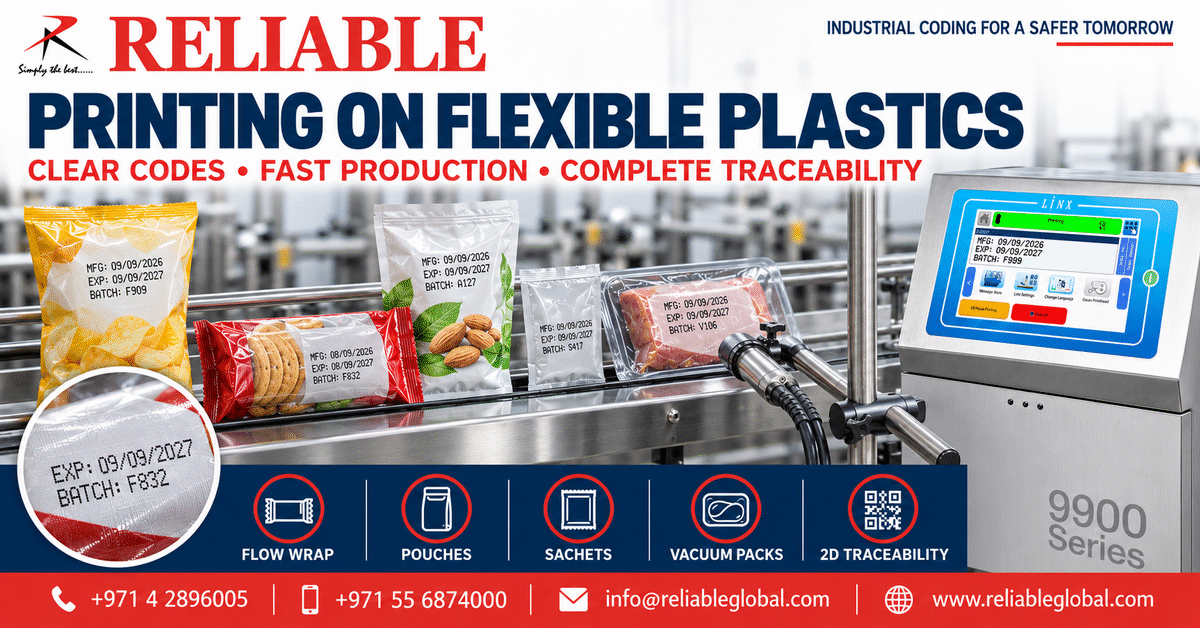
Clear, durable and high-speed coding for pouches, sachets, flow wrap, films and flexible packaging.
Printing on flexible plastics requires a coding system that can produce clear, durable information on smooth, glossy and lightweight packaging materials. Reliable Industrial Group supplies industrial coding solutions for food, beverage, pharmaceutical, cosmetics, personal-care and consumer-product manufacturers throughout the UAE.
Flexible films can stretch, move quickly and pass over rollers immediately after printing. Therefore, the selected printer must apply the code in the correct position and allow it to dry before the film contacts guides or other machine parts. In addition, the ink, ribbon or laser technology must suit the exact film structure and production environment.
Our team reviews the packaging material, machine type, line speed, code content and available mounting space before recommending a solution. As a result, customers receive a practical system designed for their actual product and production process.
Printing on Flexible Plastics for Different Packaging Formats
Flexible packaging appears in many forms and materials. Common examples include polypropylene flow wrap, polyethylene bags, laminated pouches, sachets, vacuum packs, shrink film and lidding film. Each format creates different requirements for print position, adhesion and code durability.
Manufacturers commonly print:
- Manufacturing and packing dates
- Expiry and best-before dates
- Batch and lot numbers
- Production time and line identification
- Product codes and variable information
- Barcodes, QR codes and Data Matrix codes
- Logos, symbols and handling information
- Traceability and regulatory details
A correctly integrated film printer can apply this information before forming, during packaging or after sealing. Consequently, manufacturers can select the most stable coding stage for their packaging machine and product.
Flow-Wrap Film Coding
Flow wrapping is widely used for snack foods, confectionery, bakery products, household items and consumer goods. The packaging machine pulls printed or transparent film around the product and seals it at both ends. Because the film moves continuously and may pass over rollers immediately after coding, fast drying and accurate print triggering are essential.
Continuous inkjet technology can apply compact date and batch codes without touching the film. Meanwhile, thermal transfer overprinting can create high-resolution text, graphics and machine-readable codes before the package forms. The best option depends on the required print area, machine configuration and production speed.
Printing on Flexible Plastics for Pouches and Sachets
Stand-up pouches, pillow packs and sachets provide convenient packaging for powders, liquids, snacks, spices, sauces, pet food and personal-care products. However, their flexible surfaces, seams and folds can affect code placement.
A continuous inkjet printer can code a filled pouch as it travels along a conveyor. Alternatively, a thermal transfer printer can mark the flat film before filling and sealing. Therefore, producers can choose an arrangement that protects the code from folds, seals and product contact.
For reliable results, the coder should print on a stable area with sufficient contrast. The product guide, sensor and mounting bracket must also keep the distance between the printhead and package consistent.
Vacuum-Pack and Lidding-Film Coding
Fresh meat, cheese, ready meals and other chilled products often use vacuum films or sealed trays. These packs may contain moisture, oils or condensation, so ordinary inks may smear or lose adhesion.
Specialist inks can provide better resistance to handling and light surface contamination. In addition, thermal transfer ribbons can create durable high-resolution information on suitable lidding materials before sealing. Careful sample testing helps confirm that the code remains readable through packing, storage and distribution.
Technologies for Printing on Flexible Plastics
Continuous Inkjet Printing
Continuous inkjet, also called CIJ, applies small ink droplets without touching the moving package. It can print date codes, batch numbers and variable data on filled packs, formed pouches and continuously moving film.
The Linx 9000 Series offers flexible printhead mounting and inks developed for fast drying and strong adhesion. Moreover, suitable configurations can operate in hot, dusty, humid or wet production areas. This makes CIJ a practical choice for many high-speed applications involving printing on flexible plastics.
Thermal Transfer Overprinting
Thermal transfer overprinting, or TTO, transfers ink from a ribbon onto flat flexible film. It produces high-resolution text, barcodes, ingredients and graphics. Because the code dries instantly, TTO can support packaging films that move directly into forming and sealing sections.
TTO systems can suit intermittent and continuous packaging machines. They are commonly installed on vertical form-fill-seal, horizontal form-fill-seal and labelling equipment. Different printhead widths and ribbon colours allow manufacturers to match the print area and required contrast.
Laser Coding
Laser coders can create permanent marks without ink or ribbon when the film structure is suitable. UV laser technology applies low thermal stress and can produce clean, high-contrast marks on selected thin plastic films. As a result, it reduces the risk of melting or deforming delicate material compared with unsuitable heat-based marking methods.
However, laser suitability depends on the plastic composition, colour, coating and required production speed. It also needs appropriate guarding and fume extraction. Therefore, product testing is necessary before confirming a laser system.
Challenges in Flexible Film Printing
Ink Adhesion on Smooth Films
Polyethylene, polypropylene and laminated films can have low surface energy. Consequently, standard ink may rub off or fail a tape test. High-adhesion inks designed for flexible plastics can improve resistance to handling, abrasion and some oils.
Fast and Variable Production Speeds
Form-fill-seal machines may run continuously, intermittently or at changing speeds. Therefore, the coding system must synchronise with the film movement. Sensors, encoders and correct printer settings help maintain code spacing and position.
Film Stretching and Code Distortion
Film tension, forming and heat sealing can move or distort a printed message. For this reason, the code should be positioned away from seals, folds and heavily stretched areas. Testing the complete package, rather than only a flat film sample, produces a more reliable result.
Cold or Demanding Environments
Chilled-food operations can expose printers and packaging to rapid temperature changes. Furthermore, washdown, humidity, dust and airborne oil can affect equipment and code quality. A suitable enclosure or printer protection rating can support reliable operation in these conditions.
Benefits of Reliable Flexible Packaging Coding
- Clear identification: Apply readable date, batch and traceability information.
- Fast production: Support high-speed continuous and intermittent lines.
- Strong adhesion: Select inks or ribbons for glossy and low-energy films.
- Accurate placement: Synchronise printing with product or film movement.
- Flexible formats: Code pouches, sachets, flow wrap and vacuum packs.
- High-resolution options: Print barcodes, Data Matrix codes and graphics.
- Quick changeovers: Store messages for different products and pack sizes.
- Production integration: Connect coding with packaging and control systems.
How to Select a Printer for Flexible Plastic Film
First, identify the exact film material, such as PE, PP, PVC, PET or a multilayer laminate. Next, confirm whether printing will occur on flat film, during forming or after the pack has been sealed. You should also specify whether the surface may contain moisture, oil or product residue.
Then provide the required message, print size, code colour and maximum line speed. The packaging machine type, film direction and available mounting area are also important. Finally, explain whether you need barcodes, 2D codes, automatic message selection, printer monitoring or integration with vision inspection.
These details allow our engineers to recommend the right solution for printing on flexible plastics. Product samples and videos of the packaging line can also help us confirm code quality and installation requirements.
Installation and Integration in the UAE
Good print quality depends on the complete installation. The printer needs a rigid mount, correct printhead distance and reliable product detection. In addition, cables and conduits should remain clear of moving film, rollers and sealing parts.
Reliable Industrial Group supports customers in Dubai, Abu Dhabi, Sharjah and across the UAE with selection, sample testing, installation, commissioning and operator training. We can also configure date calculations, batch formats and controlled message selection.
Explore our complete coding and marking solutions for products and packaging. You can also contact our UAE coding specialists to discuss your application.
Why Choose Reliable Industrial Group?
Reliable Industrial Group provides more than a standalone printer. Our scope can include the coding equipment, mounting bracket, sensor, encoder, beacon, protective enclosure and production-line integration. Therefore, customers receive a complete system matched to their packaging process.
Whether you need simple expiry dates on snack packs or high-resolution 2D codes on pouches, we can help you select a dependable solution for printing on flexible plastics.
Frequently Asked Questions
Which flexible packaging materials can be coded?
Industrial printers can code many PE, PP, PVC, PET and laminated films. However, adhesion and contrast vary, so sample testing is recommended.
Can expiry dates be printed on filled pouches?
Yes. A CIJ printer can apply date and batch codes as filled pouches move along a conveyor. The package should remain stable at the coding point.
What is the best technology for flow wrap?
CIJ suits compact date and batch codes, while TTO suits high-resolution text, barcodes and graphics. The correct choice depends on the machine, film and required code.
Can the code resist oil or moisture?
Specialist high-adhesion inks can resist light oil contamination, rubbing and demanding handling. Nevertheless, testing with the actual product remains important.
Can the system print QR or Data Matrix codes?
Yes. Suitable CIJ, TTO and laser systems can print machine-readable codes. The required resolution and verification standard will determine the best technology.
What information is required for a quotation?
Please provide the film material, package dimensions, code content, line speed, machine type and desired print location. Product samples and production videos are also helpful.
Request a Flexible Plastic Printing Solution
Contact Reliable Industrial Group for a practical assessment of your flexible packaging application. Our team can recommend the appropriate Linx printer, ink or ribbon and integration arrangement for your production line.
Telephone: +971 4 2896005
Mobile/WhatsApp: +971 55 6874000
Email: [email protected]
Website: www.reliableglobal.com