
Industrial Sensors – Detect | Control | Automate
Industrial sensors provide the detection and measurement signals that automation systems need. Explore object detection, distance measurement and rotary encoder solutions with Reliable in the UAE. First, share your part number or application so we can review the required function.
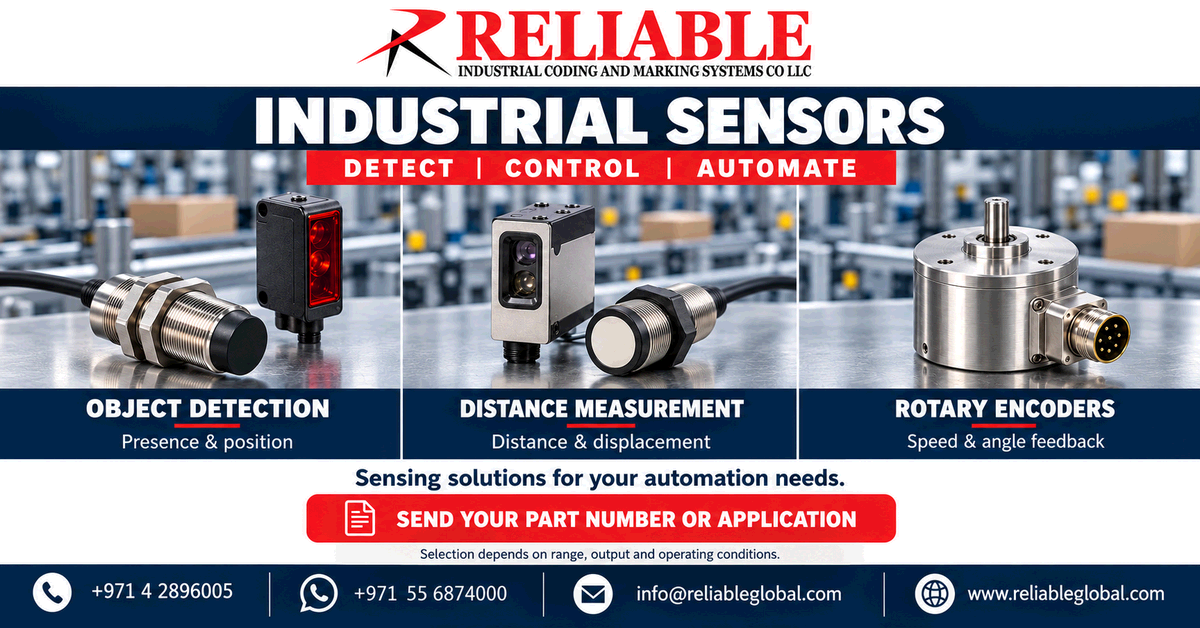
Industrial sensors for object detection
Object-detection sensors help identify presence, movement and position. For example, inductive proximity sensors detect metal targets without contact. Photoelectric sensors use light to detect objects, while capacitive and ultrasonic options address other sensing tasks.
Start with the target material and the available mounting space. Also, describe any changes in colour, transparency or surface finish. These details help narrow the sensing principle before you compare individual devices.
Distance measurement for process feedback
Distance sensors provide measurements for monitoring position, spacing or displacement. Available technologies include laser, ultrasonic, radar and inductive sensing. However, each technology has different strengths and operating limits.
For example, define both the nearest and farthest target positions in your process. Then state the smallest change you need to detect. Also, describe vibration, dust, moisture and any variation in the target surface.
Rotary encoders for speed and angle feedback
Rotary encoders provide feedback about shaft movement and angular position. Incremental and absolute designs suit different control requirements. In addition, shaft options and signal interfaces vary between devices.
Before selecting an encoder, confirm the mounting arrangement and the required electrical interface. Next, check the shaft size, resolution and operating speed. If you are replacing an existing unit, send its full label and connector details.
Choosing industrial sensors for your application
A clear requirement helps avoid selecting a device based on appearance alone. First, decide whether the task needs a switching signal or a measured value. Then confirm how the machine controller will receive that signal.
Also, include the supply voltage, output type and connection requirements in your enquiry. Provide photos showing the target and the installation space. For an existing machine, a wiring diagram can help clarify the connection details.
Finally, explain what happens when the target changes or leaves the sensing area. This helps your team define the expected behaviour before installation. Record the agreed acceptance checks so everyone can review the result consistently.
From detection to automation
Industrial sensors supply information; the controller and connected equipment determine the machine response. For example, a presence signal may trigger a coding step, while encoder feedback may support motion coordination. The complete application therefore needs a review of both sensing and control requirements.
If you are comparing a replacement, check mechanical fit and electrical compatibility together. Also, confirm whether the existing settings or controller logic need changes. A matching housing alone does not confirm that two devices are interchangeable.
Send Reliable your part number or application
Ready to discuss industrial sensors? Contact Reliable with your part number, quantity and application details. You can also explore our coding and marking solutions for related production-line requirements.
For our related coding and marking offering, visit Datecoder. Include your preferred contact details so we can follow up on the application review.
Call: +971 4 2896005 | WhatsApp: +971 55 6874000
Email: [email protected]